- The Coefficient of Restitution is 1.0 when there are no energy losses in the collision. We can't build it to exactly 1.0. Even if the rules of golf didn't say, "No higher than 0.83," the second law of thermodynamics would get in the way. (That is, no real physical process is completely lossless.) But we can get pretty close, certainly much closer than the 0.83 allowed for golf. Think about a ball bearing dropped on a heavy steel plate. Almost no loss in the collision, and the ball bounces almost as high as where it was dropped from.
- If we could swing a club that has way more mass than the ball (not just 4 or 5 times as much), we could make the ratio m/M approach zero. Let's assume an infinite clubhead mass.
- With zero loft, we get no loss of speed from oblique
impact. So the cosine of the loft is exactly 1.0.
- As we did before, we will take "miss" to be zero -- that is, a perfect sweet-spot ball strike.
And that is exact!
SF =
Vball
Vclubhead
=
1 + 1
1 + 0
* 1 * (1 - 0) = 2
The reason it isn't 2.0 for golf is that golf is real, not ideal. It is limited by the laws of golf, the laws of thermodynamics, the biomechanical necessity for a smaller clubhead mass, and the aerodynamic necessity for a non-zero loft. The fact that reality trims off very close to a quarter of this (to about 1.5) is convenient for quick calculation, but is just a coincidence and by no means exact.
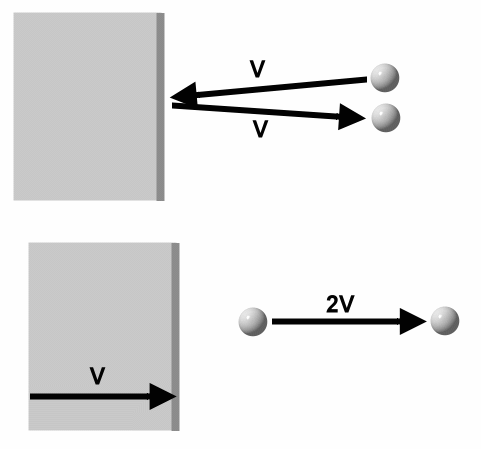 Here is a pair of
pictures you can keep in mind to understand the ideal smash factor of
2.0.
Here is a pair of
pictures you can keep in mind to understand the ideal smash factor of
2.0.The upper picture shows a ball bouncing off a stationary wall. Think of it as a ball bearing and a very heavy steel plate, with the steel plate secured to the earth -- so the wall is essentially infinite mass compared to the ball bearing. The "reflection" (the bounce) is completely lossless. If you remember any physics at all, you know that the ball bearing will rebound with exactly the same speed V that it hit the plate. Once you are comfortable with this, move on to the lower picture.
In the lower picture, the ball bearing starts out stationary and the plate is moving with a velocity V. When the plate strikes the ball, the ball will bounce off and move away from the plate at a speed of V. (That's because the physics of the bounce doesn't change just because the framework -- the plate -- is moving instead of the ball.)
But the plate has not slowed down because of the impact. Just as the infinite mass plate did not move in the upper picture, it does not slow down in the lower picture. With infinite mass compared to the ball, the transfer of a small bit of momentum doesn't affect its own speed. The plate is still moving at V after impact. Therefore... In order for the ball to move away from the plate at a speed of V, it must move at a total speed of 2V.