 Before we get down to serious studies, let's take
a very simplistic
first cut at the maximum yardage that might be gained by extra length.
As with most
of this article, we are comparing a typical 45-inch driver with a
maximum-length 48-inch driver, in the hands of someone who can swing
the 45" driver at 100mph clubhead speed.
Before we get down to serious studies, let's take
a very simplistic
first cut at the maximum yardage that might be gained by extra length.
As with most
of this article, we are comparing a typical 45-inch driver with a
maximum-length 48-inch driver, in the hands of someone who can swing
the 45" driver at 100mph clubhead speed.Let's assume that golfer can swing some ideal 48" driver with the same angular velocity as his best 45" driver. That is really the best we could expect from a longer driver, and it is easy to estimate the extra distance this might generate. Physics tells us (actually not even physics, but geometry) that the clubhead speed due to angular velocity is:
clubhead speed
= angular velocity * club length
So if we change the length, the clubhead speed due to the same angular
velocity should change in exact proportion to the length. Increase the
length 5%, and the clubhead speed increases 5%.But wait! The hands are also moving forward, adding to clubhead speed. Studies have shown that, with a good swing and centrifugal release, the hands are moving at impact at about a fifth of the total clubhead speed. We have no reason to expect the hands to speed up with a longer driver. In fact, they will probably slow down. But, since we're doing an optimistic estimate of the maximum gain, let's assume the same hand speed for the 45" driver and the 48" driver.
With the 45" driver at 100mph, the hand speed is 20mph and the speed due to angular velocity is 80mph. Let's see what increasing that 80mph proportional to the length would give us.
80 * 48/45 + 20
= 105.3mph
That's an extra 5.3mph, which gives us an extra 16 yards.So the most our golfer could expect from an extra 3" of driver length is 16 yards, using some very optimistic assumptions. We assumed no loss of either angular velocity nor hand speed from the longer driver. It is very hard to believe that gains in excess of this number can be due to physics.
Now let's see what experience and a more exact model give us.
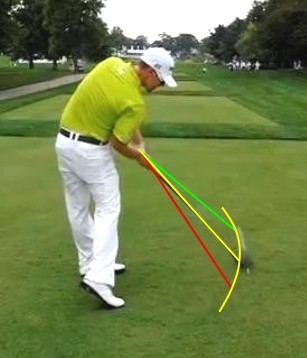 The base swing for our computer models was tuned
for a perfectly flat
wrist at impact (zero degrees). When we go to a longer or shorter
club, the same swing gives a substantial wrist angle at impact: almost
5º for a 48" driver with the same MOI as our 45" driver. What this
means to the clubface is shown in the figure to the right.
The base swing for our computer models was tuned
for a perfectly flat
wrist at impact (zero degrees). When we go to a longer or shorter
club, the same swing gives a substantial wrist angle at impact: almost
5º for a 48" driver with the same MOI as our 45" driver. What this
means to the clubface is shown in the figure to the right. At the
right is a graph of several studies. They are:
At the
right is a graph of several studies. They are: