Length
Let's start the whole-club section with the length of the club.
The reason is that, in addition to being an important characteristic
itself, it affects all the other whole-club characteristics.
That means that, if your fitting shows a golfer to need anything
but "normal" length, you will have to do something out of "normal"
to get the right
lie angle,
swingweight, and
flex.
The length of the golf club is selected primarily to match:
- The height and swing plane of the golfer.
- The length the golfer can "handle", and still make reliable contact.
First, let's look qualitatively at what length does.
Then we'll get to the fitting, where we determine the right length for
the specific golfer.
- A longer club will hit the ball further for some golfers,
up to some point of diminishing returns.
This is a benefit of length.
The factors of length that affect distance include:
-
If a longer club can be swung at the same angular speed as a shorter one,
then the clubhead speed will be greater with the longer one. The speeds
will be in the same proportion as the lengths. But this depends on being
able to maintain the same angular speed, which is hardly guaranteed. This has been studied in detail elsewhere.
In order to increase the likelihood that you can maintain angular speed...
-
Use lighter components, so you're not putting on "swingweight". We'll better
quantify this in a subsequent chapter. For now, let's just say that if you
keep the swingweight constant as you lengthen the club, you will likely
see longer shots. You can only do this by selecting lighter clubheads and/or
shafts, because swingweight increases with length if the components are not
lighter.
-
If you simply lengthen the club with the same components, the swingweight
will increase. This may still give you longer drives; it depends strongly
on how you swing the club. A smooth "swinger" may not gain any distance at
all from a longer club. A less-smooth "hitter" may pick up some distance.
(I've done some mathematical analysis that predicts this. Experiments reported
in Golfsmith's Clubmaker magazine confirm it.)
-
Of course, accuracy is an issue. If you can't hit the ball squarely with
the longer club, you may actually lose distance.
- A longer club will be less accurate beyond some point.
This is a problem with length.
It is harder to put the ball in the middle of the sweet spot as you have to
stand further from the ball and swing a longer tool at it. This is less
serious for a driver, which is normally used only if the ball is sitting
up on a tee, than for the other clubs. Where a swing must be precise in
order to hit the ball cleanly, the clubmaker should think twice before
adding length unnecessarily. The approach of Player and Woosnam, and the
48-inch driver of Rocky Thompson, may work for an experienced professional
but can produce very erratic results for a novice.
- A longer club plays as if its lie is more upright.
(Actually, it causes a flatter swing plane for the same lie.)
We'll cover this aspect in
the section on lie angle.
- A longer club feels more head-heavy. We'll cover this aspect
in the section on swingweight.
- Length interacts in a complex way with flex. We'll cover this
aspect in the section on flex.
So ultimately, a proper club length is one that is as long as the golfer
can consistently hit in the longer clubs (to maximize distance).
This must be balanced with the need to get a proper lie angle,
swingweight, and flex, all of which are also affected by length.
Measuring Length
What exactly is the length of a golf club?
Originally, the length of a club was defined as the distance
from the butt of the club
to the point where the shaft (or its extension) intersects the base of
the sole. Frankly, I have a lot of trouble with using this as a working
definition, because:
-
To be useful, length must somehow be related to the sole right under the
"sweet spot", because that's where the club strikes the ground.
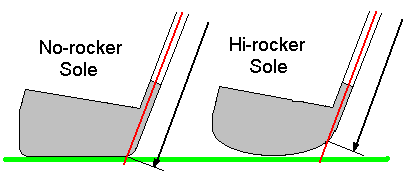 Because clubheads vary markedly in their "camber" or "rocker" (the curve
of the sole), the intersection of the shaft and the sole may be right near
the ground or considerably above it. Consider the accompanying diagram:
Because clubheads vary markedly in their "camber" or "rocker" (the curve
of the sole), the intersection of the shaft and the sole may be right near
the ground or considerably above it. Consider the accompanying diagram:
For the no-rocker sole, the intersection of shaft and sole is right on
the ground. But for the high-rocker sole, the intersection is considerably
above the ground. So the high-rocker sole is a shorter club by definition,
even though it plays at effectively the same length. |
Still looking at history and tradition, there is a practical problem
even measuring a club by this definition. The measurement called for was down
the axis of the shaft. But you can't really measure that, only estimate
it, because you can't run a ruler down inside the shaft and out
throught the bottom of  the hosel. So a more reasonable, more practical, and more
modern definition is the distance
from the butt: the hosel. So a more reasonable, more practical, and more
modern definition is the distance
from the butt:
- ... to the point where the shaft would meets the ground,
if the club were soled in a normal address and the shaft were extended
to the ground.
- ... measured along the back of the shaft and the heel of the clubhead, rather than down the axis of the shaft.
The major clubmaking suppliers offer devices
that make it easy to measure a club using this definition.
They consist of a ruler with a hinged straightedge at the "0" end.
Lay the club along the ruler with the sole against the hinged
straightedge. Adust the straightedge so it is parallel to the
grooves. Now the edge of the butt indicates the length of the
club on the ruler.
|

The
USGA and R&A made one more modification to this measurement, that
has made measurement tools less expensive and easier to use as well as
discouraging a form of "rule-beating". (Think of that as cheating
without actually breaking the rules.) They specified that, whatever the
actual lie angle of the club, the length would be measured with the
shaft at a 60° angle to the ground. This removes the need for a hinge
for the straightedge, and the need to match the angle of the
straightedge to the grooves. Easier -- and only different from the
former definition by an eighth of an inch or less. I have an article with more details on this measurement. |
Last modified May 8, 2017