 The first and perhaps most
important error in any instrument is scaling error. The first and perhaps most
important error in any instrument is scaling error.
In the graph, a perfect instrument would be the heavy black line, a
straight line at 45º. That is, the measured value y -- the reading -- would be
the same as the actual value x.
For instance, if the actual clubhead being weighed is 198 grams, then
the reading of the scale is also 198 grams.
The blue line shows what happens to the measurement if the digital
scale has a scaling
error. The reading is different from the actual value, by
an amount proportional to the actual value. There are a few other ways
to say this with precision:
- The reading of the scale is related to reality by the
equation y=Kx.
For perfect accuracy, K=1.000.
For any other value of K
there is a scaling error.
- The reading of the scale is off by a constant percentage.
Not a constant amount -- we'll get to that later -- but a constant
percentage or proportion. For
instance, if K=1.02 instead of 1.000,
then the reading is always 2% high. This gives a 2-gram error when
weighing 100 grams, a 4-gram error when weighing 200 grams, etc.
How does this sort of error occur? It is usually a calibration
error.
This can affect either analog or digital scales. For instance:
- Analog
- Analog scales generally depend on a spring for measurement. The
spring stretches or compresses in response to a force (a weight); the
change in the length of the spring is measured and read as a
force from markings on the scale. In order to do the conversion
correctly, the scale manufacturer has to
know the "spring constant" of the spring -- the ratio of force to
elongation.
It is well known that standard springs have a 10% tolerance
on their spring constant. 10% is too big an error for any kind of
scale, so the scale manufacturer will pay extra for a lower-tolerance
spring. How much more money, for how much lower tolerance? That is what
will determine the scaling error for the analog scale.
- Digital
- Many digital scales today have a "calibration" feature that works
like this: You put a known accurate weight (specified and often
supplied by the manufacturer) on the scale and hit a "calibration"
button. It then determines the "K"
of the scale, and adjusts the readout so the scale behaves as if K=1.000. A
calibrated scale is only as accurate as weight you use to calibrate it.
Horrible example: An acquaintance of mine saw that his scale
required (according to the manufacturer's instructions) a 10-kilogram
weight for calibration. He didn't have an exact 10-kilogram weight in
the shop. But he knew that 10 kilograms is about 20 pounds, so he
borrowed a [very accurate, he was assured] 20-pound weight from the
fitness store next door, and used that to calibrate the scale. Well, 10
kilograms is actually 22.05 pounds. Yes, that's "about 20 pounds" --
with a 10% difference. So his "calibrated" (actually miscalibrated)
scale now had a 10% error. This high-resolution, very precise digital scale had an accuracy
problem of 10%. He weighed a 198g clubhead and got a
reading of 218 grams -- and he wondered why.
|
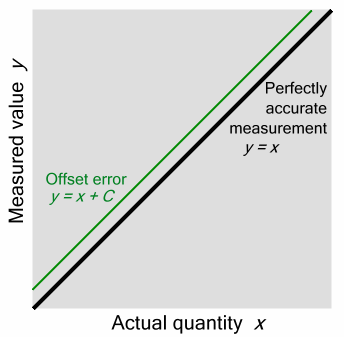 The next kind of error we will look at is offset. This occurs when every reading is high (or low) by a constant amount, or constant offset. The next kind of error we will look at is offset. This occurs when every reading is high (or low) by a constant amount, or constant offset.
Offset
errors are very easy to eliminate in digital instruments (or electronic
instruments in general). Most electronic instruments have some sort of
"zero adjustment"; you provide the instrument with a zero input (e.g.-
no weight on the scale) and tell it "this is zero". Examples:
- Digital scales usually have a "Tare/Zero" button for exactly this purpose.
- Many
analog meters have a "zero adjust" knob or screw. With a zero input to
the instrument, turn the knob so that the output is zero. Now the
instrument has no offset error.
Zero adjustments assure
that there is no output with zero input; that is, the instrument is
perfectly accurate at zero. When this is adjusted properly, then any
accuracy problems are something other than offset.
But
offset errors can still creep in if we are not careful. In particular,
it is sometimes hard to identify a zero (or any other arbitrary)
"standard" to use as a zero adjust or tare. Case in point: A clubmaker
added a Wixey to his loft/lie
machine. (A Wixey is a digital angle gauge that can measure its own
orientation to 0.1º.) He concluded that he could now measure lie angle
to 0.1º. The problem was that, without the Wixey, there was no way to
tell lie angle to better than a half degree with his L/L machine. So
there was no way to position the Wixey on the L/L machine oriented
within 0.1º.
For instance, suppose we have a standard club that
we know is 60º, and use that to set the Wixey so it reads 60.0º.
That solves the problem, right? Well, maybe. Consider... how do we know
that the standard club is 60º? Because we measured it in another
machine. OK then, how accurate was this other machine? Was it a full
0.1º accuracy machine? If not, our 60º standard club might actually be
60.3º. If we use it to orient the Wixey on our machine, we have an
instrument with an offset error of 0.3º. It measures lie differences to 0.1º accuracy, but it will measure absolute lie with the same 0.3º error every time.
|
 The final common accuracy error is linearity error. It is often the hardest to avoid building in real-world instruments. The final common accuracy error is linearity error. It is often the hardest to avoid building in real-world instruments.
In
the graph, the red curve matches the black line for zero input; so this
instrument has no offset error. It also matches the black line
near the top-right of the graph. So this instrument does not have any
percentage error at that point; we can't accuse it of scaling error.
If
the actual response is perfectly accurate for at least two
[widely-separated] input values, but inaccurate for other values, then
the instrument's response curve cannot be a straight line. That's just
geometry. The perfect response curve y=x
is a straight line. Two points determine a straight line. So, if the
actual response curve matched at two points and was a straight line, it
would be the same straight line as the perfect response curve. Q.E.D.
If the response curve is not a straight line, then it is nonlinear as mathematicians and engineers would say. Inaccuracies of this type are referred to as nonlinearities.
We
have already pointed out that analog scales frequently have scaling
errors because of tolerances on the spring constant. They also often
have nonlinear errors. To prove to yourself where these errors might
come from, take a fairly flexible coil spring and start stretching
it. For a while the length increases in proportion to the force you
apply. You can see and feel that. But, at some point, the coils are
less flat and more angled. The spring is straightening out. Now
it takes a greater increase of force to get the same increase of
length. Eventually the spring is mostly straight, and you can apply a
lot more force with almost no additional increase in length.
This
results in a nonlinear response curve like the one in the graph. As the
spring stretches, its rate of length increase becomes less, and the
curve gets "flatter" as shown.
|
 A
digital scale has a different kind of linearity problem. The problem
stems from the necessity to convert a weight (an analog quantity) into a
digital number. This conversion process, called "quantization", is a necessary
function of most digital instruments. A
digital scale has a different kind of linearity problem. The problem
stems from the necessity to convert a weight (an analog quantity) into a
digital number. This conversion process, called "quantization", is a necessary
function of most digital instruments.
Example: a 500-gram scale with a 0.1-gram resolution must quantize its input to one of 5000 values -- 0.0g through 499.9g.
The
circuitry to do the quantization must be manufactured very accurately. This
graph reveals a quantization circuit (D/A converter) with an inaccurate
electronic component converting one of the bits. (It happens to be the
second-most-significant bit for you binary number fans.) The error
shown in the graph is unusually large, but smaller errors of this kind
are not uncommon. That is why my article on digital scale testing stresses looking for nonlinearity errors.
|

 Imagine you have a rifle with a telescopic sight.
When you shoot with it, you get a pattern like the one at the left. Not
very good.
Imagine you have a rifle with a telescopic sight.
When you shoot with it, you get a pattern like the one at the left. Not
very good. No it does not! You now have a much tighter
distribution. But, on average, you're just as far from the bull's eye.
The real problem was not that the scope did not
show the target well enough; the scope was aligned wrong.
No it does not! You now have a much tighter
distribution. But, on average, you're just as far from the bull's eye.
The real problem was not that the scope did not
show the target well enough; the scope was aligned wrong. OK, so we can improve precision without improving
accuracy. Does it work the other way, too? Can we improve accuracy
without improving precision?
OK, so we can improve precision without improving
accuracy. Does it work the other way, too? Can we improve accuracy
without improving precision? Finally, just to complete the picture, here's
high accuracy with high precision. This would result from working on
both the alignment and the optics.
Finally, just to complete the picture, here's
high accuracy with high precision. This would result from working on
both the alignment and the optics.