 Let's
start
with the old method of measurement. Here is a picture from an article
by Jeff Summitt at the Hireko web site
showing the traditional way. The length was measured along the
shaft, from the floor to the butt of the grip, with the head level.
That meant that the angle of the shaft (and the angle of the ruler) was
the lie angle of the club.
Let's
start
with the old method of measurement. Here is a picture from an article
by Jeff Summitt at the Hireko web site
showing the traditional way. The length was measured along the
shaft, from the floor to the butt of the grip, with the head level.
That meant that the angle of the shaft (and the angle of the ruler) was
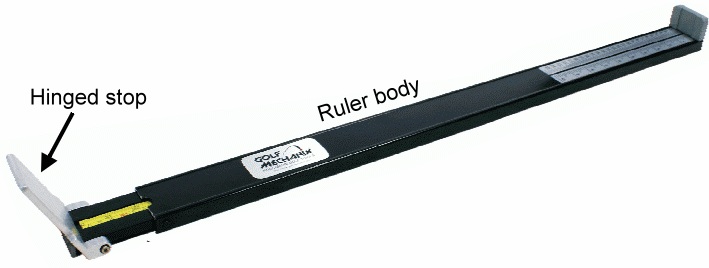
the lie angle of the club.Instrument makers built their club rulers to this method. The example shown below is from GolfMechanix, and is typical of a pre-2004 club ruler. The shaft of the club lies along the ruler, and the sole of the clubhead presses against a hinged stop. The angle of the stop is adjusted so that it equals the lie angle. With the sole resting against a stop set at the lie angle, the geometry is exactly the same as the diagram to the left. The length measured along the ruler is the length of the club.
The New Way
Now along come the rule-makers, who want to put a limit on the maximum length of a driver. Being experienced rule-makers, they don't want any loopholes, any way to "game" the rules. And one way to game the rules is to lie about the lie -- that is, to assure that the lie angle as measured is very different from the lie angle as played. This is easy to do for a driver. Consider:
- Lie measurement is usually taken assuming that the scorelines on the face are perfectly horizontal at address. And that is the case, if the clubhead was made without any ulterior motives. But...
- Grooves do nothing for a driver. Launch conditions are not influenced at all by a smooth face, horizontal grooves, vertical grooves, or grooves at any angle you want.
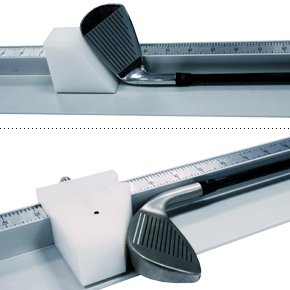
In order to head off such gaming, the rule makers said the angle of the sole stop had to be 60º -- as opposed to hinged and matched to the lie angle. 60º is well within the range of lie angles across the bag, and closer to the driver end of the bag. Sounds like a reasonable way to measure, if the goal is to control maximum driver length.
 So
a lot of clubmakers and instrument makers said, "OK, there's a new way
to measure club length. Let's redesign the club ruler to this new
method." Certainly worthwhile if you need to be sure you are building a
legal driver. Here is a picture of GolfMechanix' product to meet that
need. It has a
non-hinged solid sole stop, cut at a 60º angle. This actually has a
number of advantages over the old way:
So
a lot of clubmakers and instrument makers said, "OK, there's a new way
to measure club length. Let's redesign the club ruler to this new
method." Certainly worthwhile if you need to be sure you are building a
legal driver. Here is a picture of GolfMechanix' product to meet that
need. It has a
non-hinged solid sole stop, cut at a 60º angle. This actually has a
number of advantages over the old way:- Inexpensive. Certainly less expensive than a good hinged stop.
- Easy to use. No need to adjust the stop to align it with the scorelines, in order to get the lie angle right.
- Harder to misuse. You can't accidentally bump the stop to a flatter angle as you are setting the club in the ruler. (Don't laugh; that has been done, and not infrequently.)
Of course it doesn't! The different angle of the stop will give a different measured length. The real question is "how different?" That is what this article is about.
 No, really! What
 Here is the
geometry of the problem we are trying to
solve. The elements are:
Here is the
geometry of the problem we are trying to
solve. The elements are: Let's look at
the problem in more detail. We'll complete
the green and blue right triangles, and see what we can deduce. Let's
label distances along the ruler (or even just parallel to the ruler) as
Let's look at
the problem in more detail. We'll complete
the green and blue right triangles, and see what we can deduce. Let's
label distances along the ruler (or even just parallel to the ruler) as
 All
we need now is X3. To find it, we will take a closer look at the area
where the stops are tangent to the sole curve. We can draw another
right triangle, this one shown in red. If we knew
All
we need now is X3. To find it, we will take a closer look at the area
where the stops are tangent to the sole curve. We can draw another
right triangle, this one shown in red. If we knew