 That
was when George Hodgetts got into a discussion with me about kick
velocity. We still haven't agreed on that issue, but he sent me some
very interesting traces as part of the discussion. George has built his
own version of ShaftLab, attaching four strain gauges to a shaft in a
quadrature configuration -- just like ShaftLab. They are lower on the
shaft -- the midpoint rather than just below the handle -- but the idea
is the same. George's traces looked nothing like any of the traces I
have seen nor measured myself with ShaftLab. How do we explain the
difference?
That
was when George Hodgetts got into a discussion with me about kick
velocity. We still haven't agreed on that issue, but he sent me some
very interesting traces as part of the discussion. George has built his
own version of ShaftLab, attaching four strain gauges to a shaft in a
quadrature configuration -- just like ShaftLab. They are lower on the
shaft -- the midpoint rather than just below the handle -- but the idea
is the same. George's traces looked nothing like any of the traces I
have seen nor measured myself with ShaftLab. How do we explain the
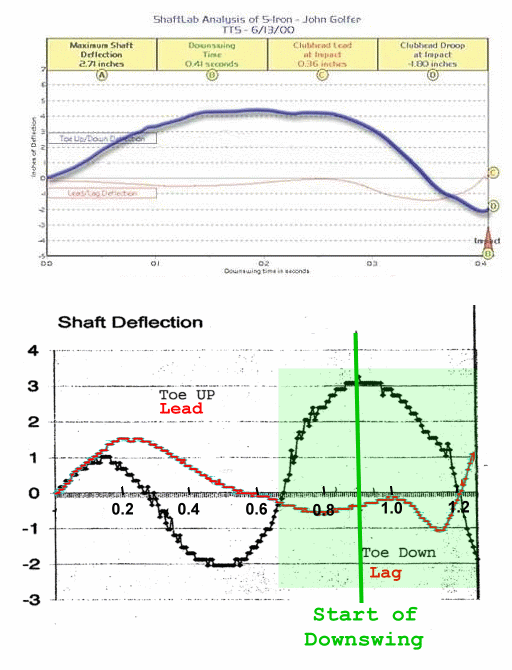
difference?After I wrestled with it for a bit, I found a way to look at George's traces in a comparable way to one from ShaftLab. In the picture at the right, we have a single-hump ShaftLab graph on top, and George's graph on the bottom. Here are the things I had to do to get some measure of equivalence:
- Combine separate traces on one set of axes. Red for lead/lag and dark for toe up/down.
- Scale them to look more like the ShaftLab traces. George's had both curves with the same maximum deflection of 3 inches. I don't know why it did (doesn't make sense to me), but I halved it for the graph to a maximum of 1.5 inches. That gets it part way to what ShaftLab looks like. While I did that, I also inverted it to the same direction as the ShaftLab curve (that is, lead deflection is positive).
- I also changed his axis labeling from sample count to seconds, for easy comparison to ShaftLab.
- I marked off a section and shaded it in green, corresponding to the ShaftLab trace. If you look at the green-shaded area, it has very much the same shape as the ShaftLab trace. Yes, there are significant differences, but there are substantive differences from trace to trace out of ShaftLab. That is its effectiveness as a fitting tool; it captures differences as well as similarities in swings.
How can that be? One possible explanation might be that a ShaftLab trace starts way before the downswing. That would also be consistent with my earlier observation about the duration of ShaftLab traces: 400-600ms, compared with known downswing durations of 200-350ms. How can we test this hypothesis?
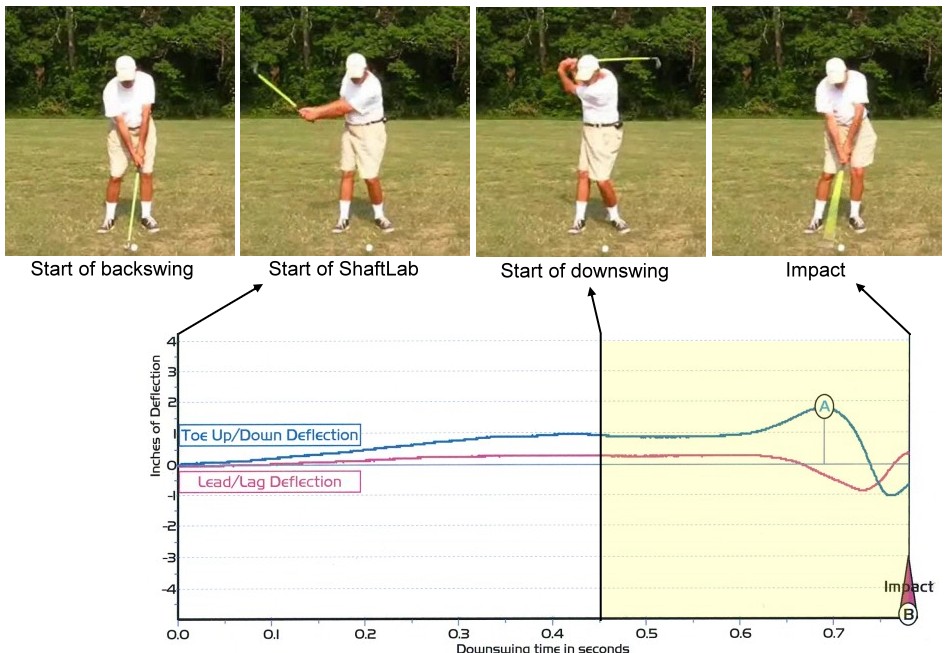
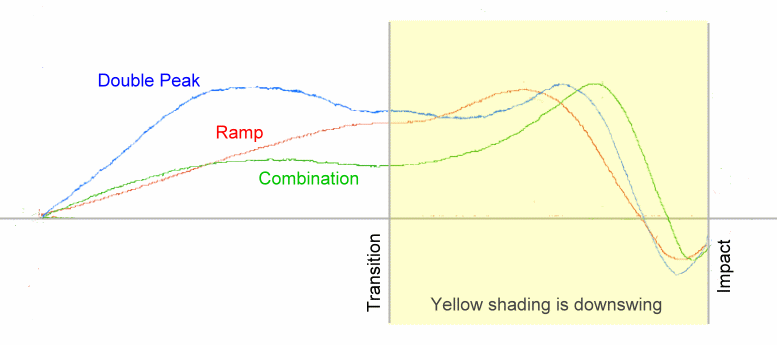
My swing is closer to a "ramp" rather than a "one-hump" swing, and the conclusion is even more extreme than George's. Only 42% of my ShaftLab trace is downswing; that would be the yellow-shaded portion of the ShaftLab graph. This is pretty strong confirmation of our inference from George's graph.
There is nothing particularly odd about either George's swing nor mine. Since we're talking about time durations, we could do a sanity check by comparing both swings against Novosel's "Tour Tempo" hypothesis: ideal swings have a ratio of 3:1 for backswing time vs downswing time. George and I have monitored this for our own swings over the years. He has been stable at 2.7:1 and I have been stable at 2.9:1. So both our swings have timing that is consistent with good golf swings. The issue has to be with ShaftLab's algorithm to determine the start of the backswing; it doesn't work very well.
I have gone back and looked at the rest of my conclusions in this article. Only one depends on this flaw in the ShaftLab algorithms: the statement about the time and direction of maximum bending. I have rewritten that part to conform to the new information.
 A
close examination of the
A
close examination of the 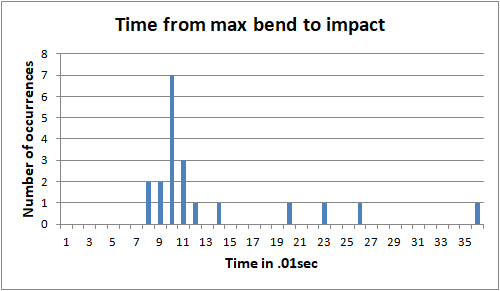 So there is
nothing consistent we can say about
So there is
nothing consistent we can say about 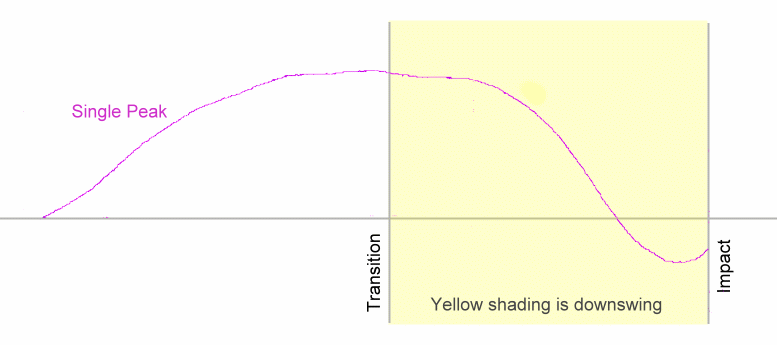
 With
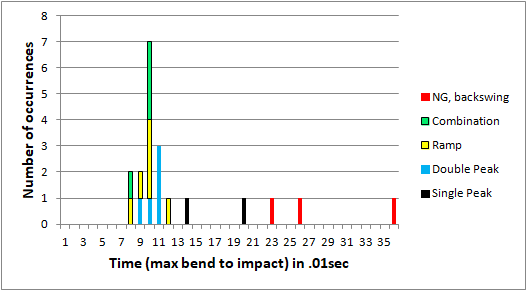
this in mind, let's revisit the distribution of time between peak bend
and impact. Here is the same chart, but color-coded with the swing type
for each measurement. I see three distinct clusters of data:
With
this in mind, let's revisit the distribution of time between peak bend
and impact. Here is the same chart, but color-coded with the swing type
for each measurement. I see three distinct clusters of data: