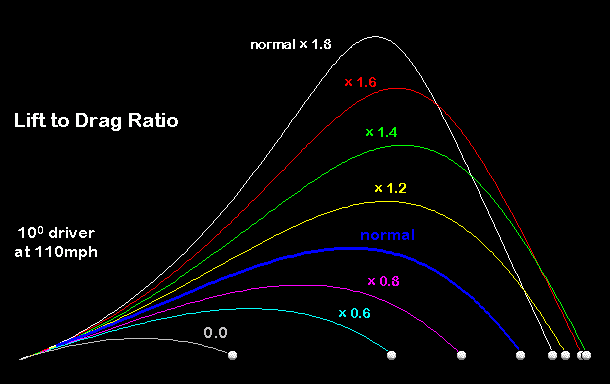
Now we know that the price of ballooning
changes with clubhead speed. Let's look at this a little more closely,
since it is so important to clubfitting -- especially drivers. Today,
the state-of-the-art
method of fitting drivers is with launch monitors, and the thing the
launch monitors look at are, of course, the launch conditions: ball
speed, launch angle, and spin. How do these relate, when the objective
is maximum carry distance?
Engineers
and mathematicians would call this the "launch space". It is a graph
that starts with the launch parameters and plots the carry distance.
That's a four-dimensional space (ball speed, launch angle, spin, and
distance), which is hard to show on a two-dimensional page. But let's
see if we can find some useful ways to visualize it.
 Here's
how carry distance varies with spin for several representative ball
speeds.
For each speed we used a good launch angle for that speed and just
varied the spin. Points to note: Here's
how carry distance varies with spin for several representative ball
speeds.
For each speed we used a good launch angle for that speed and just
varied the spin. Points to note:
- The
four ball speeds used were:
- 100mph -
a senior or less athletic golfer, with a clubhead speed about 70mph.
- 130mph - this represents good impact at 85-90mph. It
corresponds to the majority of decent golfers.
- 160mph
- a big hitter that you might run across at your course.
- 190mph
- one of the bigger hitters on the pro tour, but not yet a serious
competitor in long drive championships.
- The best spin for the 190mph golfer was about 2000rpm,
while the 100mph golfer did best above 3000rpm. Actually, the optimum
was probably around 4000rpm, but the distance was very close to that at
3000rpm.
- For
the 190mph golfer, that 2000rpm was with a launch angle of 10°,
while the 100mph golfer had a launch angle of 20° and did best
over
300rpm.
So the effect of spin is even more than it appears. That's because the lower
launch angle needs more spin to keep the ball in
the air.
|
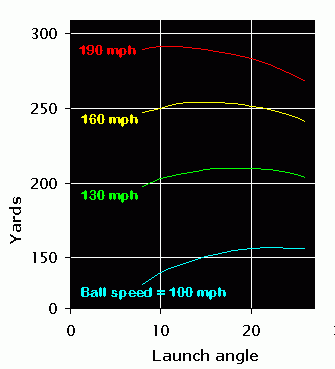
Now let's look at the other side of the picture: launch angle. Here are
the corresponding plots, using a good spin for each speed and plotting
distance against launch angle.
- The
golfer with the highest ball speed does best with the lowest launch
angle: 190mph at 11°. The best launch angle for a golfer with
only
100mph ball speed is more than double that, at 23°.
- As
before, we held the spin constant at a "good" value for
each ball speed. That spin varied from 2000rpm for the 190mph golfer to
3500rpm for the 100mph golfer.
One of the most startling things on this page is how high the optimum
launch angle is for most golfers. Next we'll see what's really going on.
|
Now
we've seen how distance varies with spin, and how it varies with launch
angle. But it's very instructive to see how distance varies with both
at the same time. Let's add a dimension to what we're looking at.
Here's a chart that shows more of the launch space --
distance vs both spin and launch angle for a ball
speed of 124mph.
(That corresponds to a well-struck ball off a driver whose head speed
is 85mph, comparable to a typical male golfer.)
Spin
(rpm) | Launch Angle (Degrees) | | 8 | 10 | 12 | 14 | 16 | 18 | 20 | 22 | 24 | 26 | | 5500 | 193 | 195 | 196 | 196 | 195 | 194 | 192 | 190 | 187 | 183 | | 5000 | 193 | 195 | 197 | 197 | 197 | 196 | 194 | 192 | 189 | 185 | | 4500 | 192 | 195 | 197 | 198 | 198 | 197 | 196 | 194 | 191 | 188 | | 4000 | 191 | 195 | 197 | 199 | 199 | 199 | 198 | 196 | 193 | 190 | | 3500 | 190 | 194 | 197 | 199 | 200 | 200 | 199 | 198 | 195 | 193 | | 3000 | 187 | 192 | 196 | 198 | 200 | 200 | 200 | 199 | 197 | 195 | | 2500 | 183 | 189 | 194 | 197 | 199 | 200 | 201 | 200 | 199 | 197 | | 2000 | 178 | 185 | 190 | 195 | 197 | 199 | 200 | 200 | 200 | 198 | | 1500 | 170 | 179 | 185 | 190 | 194 | 197 | 199 | 199 | 200 | 199 | | 1000 | 159 | 168 | 177 | 183 | 188 | 192 | 195 | 197 | 198 | 198 |
Because
it is difficult to make much sense of a table of numbers, I have
color-coded it to give it some contour -- so the colors are the third
dimension. The colors go from hot (red) at
the maximum distance of 201 yards to cool (blue) for all distances
under 194 yards. While the location of the peak is pretty clear, the
shape of the space is interesting. 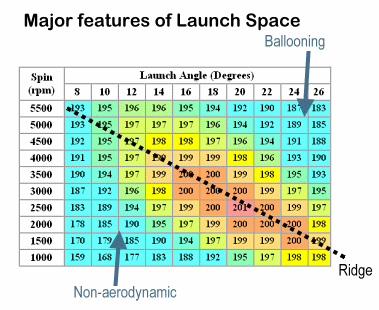 The
peak appears to be on a "ridge" of good yardage that runs from upper
left (low launch, high spin) to lower right (high launch, low spin). The
peak appears to be on a "ridge" of good yardage that runs from upper
left (low launch, high spin) to lower right (high launch, low spin).
The
smaller, annotated picture at the right shows where the ridge is.
Distance falls off rapidly on either side of the ridge. At the lower
left -- low launch and low spin -- distance is lost because there isn't
enough aerodynamic lift to keep the ball in the air. At the upper right
-- high launch and high spin -- ballooning kills the distance. But
moving along the ridge, you can change launch angle and spin by pretty
large amounts with fairly little loss of distance.
"Moving
along the ridge" means you have to change both angle and spin so you
stay on the ridge. Let's see what happens if you just change one or the
other. Suppose you had a driver that launched the ball at 124mph (this
whole table assumes a ball speed of 124mph), with a 14º launch
angle and
a 4000rpm spin. The resulting distance is 199 yards. The peak distance
of 201 yards lives at 20º and 2500rpm.
- Suppose
you changed the launch angle to 20º without changing the spin.
You would lose a yard, to 198 yards.
- Suppose you
changed the spin to 2500rpm without changing the launch angle. You
would lose two yards, to 197 yards.
But, if you
change both, you'll pick up the two yards to the theoretical maximum.
|
 This
is very significant in the fitting of drivers. Here is a table showing
a "family" of drivers. The design is very simple: 200g clubhead, a COR
of 0.83 (the maximum allowed by the USGA), nothing fancy about the
weight distribution, etc. Each row of the table shows a different loft;
that is all that is varied from one driver to another in the "family".
(Actually, it is effective loft at impact, a number which includes the
effect of shaft bend.) This
is very significant in the fitting of drivers. Here is a table showing
a "family" of drivers. The design is very simple: 200g clubhead, a COR
of 0.83 (the maximum allowed by the USGA), nothing fancy about the
weight distribution, etc. Each row of the table shows a different loft;
that is all that is varied from one driver to another in the "family".
(Actually, it is effective loft at impact, a number which includes the
effect of shaft bend.)
What the table shows for each
driver is
the distance, launch angle, and spin for each driver in the family --
assuming the ball is being struck at an 85mph clubhead speed and a zero
angle of attack.
|
 Because
we have a distance, LA, and spin for each driver, we can plot the
drivers on the launch space table we just calculated. When we do this,
we see them lying along the red dotted line. A few points worth noting
here: Because
we have a distance, LA, and spin for each driver, we can plot the
drivers on the launch space table we just calculated. When we do this,
we see them lying along the red dotted line. A few points worth noting
here:
- Increasing loft increases both the
launch angle and
the spin. This means that it does not move along the ridge, but almost
at right angles to it.
- Since it crosses the ridge
at a right
angle, there is a fairly well-defined maximum distance as you vary the
loft. And the maximum along the red line of loft variation is where it
intersects the black line of the ridge. This should not be a big
surprise when you think about the shape of the contours on the chart.
- The
maximum distance along the red line is a long way from the
peak
of the launch space. The difference is 6º of launch angle
(14º to 20º), and 1500rpm of spin (4000rpm to
2500rpm). Even
so, the distance that driver can hit the ball is only two
yards short of the theoretical maximum for that ball speed.
This
last point is important! It tells us that a practical, well-fit driver
is one that lives at the top of the ridge. It doesn't have to be at the
peak, but it can still give almost as much distance as the peak. I've
plotted the same chart for clubhead and ball speeds from long-drive
champions to little old ladies from Pasadena. The simple driver that
lives on top of the ridge is never more than 2 yards short of the
theoretical maximum. |
 The first picture shows air flowing past a non-spinning ball.
The air flows to the right, but that is the same aerodynamically as the
ball moving to the left through the air. Think of it as a picture of
the moving ball, with the camera moving along with the ball. A few ways
to look at
this:
The first picture shows air flowing past a non-spinning ball.
The air flows to the right, but that is the same aerodynamically as the
ball moving to the left through the air. Think of it as a picture of
the moving ball, with the camera moving along with the ball. A few ways
to look at
this: This time, the ball is spinning
clockwise in the left-to-right flow of air, corresponding to backspin.
The effect of the spin is to deflect the air downward as it streams
past the ball. So, in addition to disturbing the airflow, the ball is
pressing the air down.
This time, the ball is spinning
clockwise in the left-to-right flow of air, corresponding to backspin.
The effect of the spin is to deflect the air downward as it streams
past the ball. So, in addition to disturbing the airflow, the ball is
pressing the air down.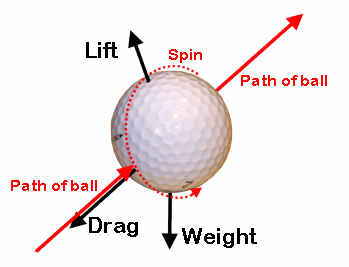 The
result is a collection of forces as the ball moves through the air. The
ball's motion is described by its speed, direction, and spin at any
point along its path. The forces are:
The
result is a collection of forces as the ball moves through the air. The
ball's motion is described by its speed, direction, and spin at any
point along its path. The forces are: The
spin plane doesn't have to be straight up and down. In this picture,
the
spin plane is inclined a little to the left, so the lift force (black
arrow) is also inclined to the left. Therefore, it has components (gray
arrows) upward and leftward. Yes, lift still produces an upward force.
But it also has a force to the left. This will be a centripetal force,
which will curve the flight of the ball to the left... a hook for a
right-handed golfer.
The
spin plane doesn't have to be straight up and down. In this picture,
the
spin plane is inclined a little to the left, so the lift force (black
arrow) is also inclined to the left. Therefore, it has components (gray
arrows) upward and leftward. Yes, lift still produces an upward force.
But it also has a force to the left. This will be a centripetal force,
which will curve the flight of the ball to the left... a hook for a
right-handed golfer.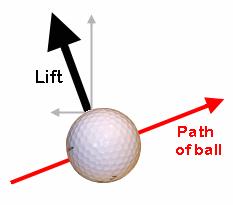 During
the time that the ball is climbing, the path of the ball is tilted
upward. Since the lift force has to be perpendicular to the path of the
ball, it is tilted "backward". That is, the lift has an upward
component keeping the ball in the air, and a backward component
decelerating the ball from it's progress down the fairway. So the ball
slows down during its climb, not just from drag but also due to the
backward tilt of the lift.
During
the time that the ball is climbing, the path of the ball is tilted
upward. Since the lift force has to be perpendicular to the path of the
ball, it is tilted "backward". That is, the lift has an upward
component keeping the ball in the air, and a backward component
decelerating the ball from it's progress down the fairway. So the ball
slows down during its climb, not just from drag but also due to the
backward tilt of the lift.