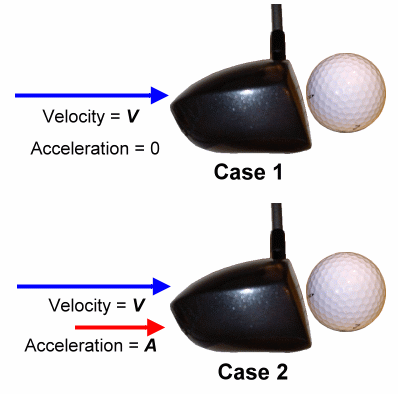
 If we are going to
seriously consider the question, we have to state
the premise less vaguely. We are going to compare:
If we are going to
seriously consider the question, we have to state
the premise less vaguely. We are going to compare:- Ball speed for a clubhead arriving at the ball at V miles per hour with no acceleration.
- Ball speed for a clubhead arriving at the ball at V miles per hour (same clubhead speed) with a positive acceleration of A.
Note that I did not ask, "Is case 2 faster?" I asked for numbers. Numbers matter! If it is only a fraction of a mile-per-hour faster then, for all practical purposes, there is no difference. It makes no sense to say, "You get more distance by accelerating through the ball," if that extra distance is so small you can't even measure it reliably. However, if it is several miles-per-hour faster, that is a distance gain worth seeking.
(Brief digression on this point. Much of my writing on this site is aimed at custom clubfitters and clubmakers. I have seen so many clubmakers spend a lot of time optimizing one parameter while ignoring or giving short shrift to a different parameter -- one that matters a lot more. Why? Because they know how to measure and adjust -- sometimes with great precision -- the one they spend time on. Old proverb: "When all you have is a hammer, you tend to treat everything as a nail." This article is about instruction, not clubmaking, but we are investigating a similar phenomenon -- focusing on something that makes a tiny difference, perhaps at the expense of something else that is important.)
Simplified analysis #1 - Forces on the ball
Let's use 100mph as the clubhead speed. I have done some computer
simulations of good swings, and you might see an acceleration of almost
500 feet per second per second (500 ft/s/s) just before impact. We'll
use 500 ft/s/s as the clubhead acceleration for case 2.Impact lasts 0.0004 second (0.4msec). During that time, the force the clubhead exerts on the ball averages about 1600 pounds. (We need that much force in order to accelerate a 46-gram ball to 150mph in 0.4msec.)
For this analysis, we focus on the forces between the clubhead and the ball. The clubhead is a low-loft driver, so we don't have to worry about a glancing impact; we can use the simple impact formulas.
Case 1:
If the clubhead is not accelerating at impact, that 1600 pounds is the force. Period!
Case 2:
If the clubhead is accelerating, then there is a force on the clubhead making it accelerate. F=ma! We decided to use 500 ft/s/s as the acceleration at impact. When we crank this into F=ma (along with 200g for the mass of the clubhead), we get a force of about 7 pounds accelerating the clubhead.
Let's make the most generous assumption: all the force of the clubhead's momentum and all its accelerating force helps to accelerate the ball. So we have:
1600 pounds due to the clubhead's momentum. 7 pounds accelerating the clubhead.
That is less than half a percent. So the acceleration is worth less than an additional 1/2mph of clubhead speed, or an extra distance of less than 1.5 yards. Hardly worth concerning yourself with, unless you are a long drive competitor and pure yards are the way you keep score.
Simplified analysis #2 - Clubhead speed
Let's try another way of looking at it. What would the clubhead speed be immediately after impact, if the clubhead had not lost any momentum from impacting the ball?
Why would this matter? If the ball were not there, we have a speed before impact and another one 0.4msec after impact (i.e.- after separation). The clubhead speed that would be applied to the ball is somewhere between these two. So let's find both.
Case 1:
The clubhead speed coming into impact is 100mph. That is one of our original assumptions.
Since Case 1 is the case of zero acceleration, the speed 0.4msec later is still 100mph.
Case 2:
Again, by assumption, the clubhead speed coming into impact is 100mph.
We have an acceleration of 500 ft/s/s. Therefore, in the duration of impact, the change of velocity is given by the acceleration times the time the acceleration is happening:
Change of velocity = 0.0004sec * 500 ft/s/s = 0.2 ft/sec = 0.14 mph
Velocity 0.4msec after impact = 100 + 0.14 = 100.14mph.
So, out of a clubhead speed of 100mph, the acceleration gives us a boost of only 0.14mph. That's only than a 0.14% gain, and represents an extra 15 inches of distance on the drive. Note that it is the upper bound of the gain in ball speed that you could expect; the actual distance gain will be less. It is even less than Simplified Analysis #1; this one is probably negligible even for a long drive competitor. (Not zero, true. But negligible.)
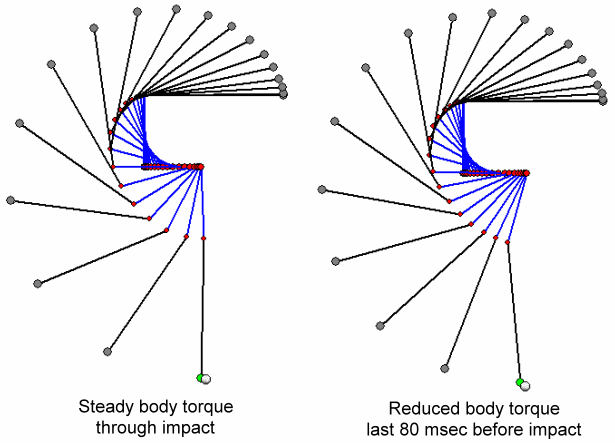
 We've
already debunked the notion that you get more ball speed from an
accelerating clubhead. But there's another reason not to try to
accelerate the clubhead -- at least not unless you are
We've
already debunked the notion that you get more ball speed from an
accelerating clubhead. But there's another reason not to try to
accelerate the clubhead -- at least not unless you are 
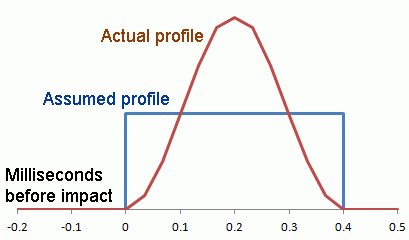 One last
point: These calculations are
based on a constant force -- the
average force -- during contact between clubhead and ball.
One last
point: These calculations are
based on a constant force -- the
average force -- during contact between clubhead and ball.