A Driven Double Pendulum
The improved model can vary:- Torque applied to the inner arm of the pendulum, to model the work done by the golfer via the torso and shoulders
- Torque applied to the outer arm of the pendulum, to model work done by the golfers hands
- Wrist cock angle
- Release timing, to model the golfer releasing the club early or late during the first phase of the downswing
- Arm mass
- Arm length
- Club shaft length
- Club head mass
- Coefficient of restitution for the club-ball collision
 For the
moment we will focus on the aspects of technique that have the largest
effect on the effectiveness of the golf swing – we will look at the
technological factors later.
For the
moment we will focus on the aspects of technique that have the largest
effect on the effectiveness of the golf swing – we will look at the
technological factors later.The animation shows the swing of a moderately good amateur golfer with a sound golf swing.
During the first part of the downswing, the golfer holds the club in a cocked position and accelerates the shoulders and torso. Initially some positive wrist torque is required to stop the club from being pulled into the golfers neck (the hub). Remember the passive, steadily rotating model on the previous page? There, a string (providing negative torque) was needed to keep the club from swinging outward. Here, during the initial build up of speed, some sort of "brace" (providing positive torque) is needed prevent the club from being pulled inward. The positive torque required to brace the club falls rapidly as the club accelerates. When the positive ‘bracing’ torque falls to zero, the club can be allowed to swing out -- ending the first phase.
The second phase of the downswing occurs as the club swings out. If the golfer lets the club swing out when the bracing torque falls to zero, then this is described as a swing with a natural release. If the golfer holds the club in the cocked position for a short while longer, this is described as a late release. If the golfer releases the club early, the club will swing in towards the neck for a small moment and then swing out. We won’t look at the effect of release timing because to a good approximation release timing has no effect.
During the second phase the golfer continues to turn his body and arms, but no torque is applied via the hands – they are no more than a hinge during this phase.
This model will be the starting point for all our future calculations. The full numerical model includes a number of variable factors, as indicated in the list above. The animation shows the solution for the swing we have just described.
Important note:
By pure coincidence (perhaps), the golf swing can be executed with the natural release. This is not necessarily true for all stick-and-ball sports, not even if the stick is a golf club. Consider:
- With baseball swings, the natural swing time is much shorter because the bat is shorter, and the base-baller must restrain the bat using negative wrist torque to stop it from swinging out early.
- With professional long-drive golfers, the shaft length is longer (up to 50 inches), the natural swing time is much longer, and a swing with a natural release is anatomically impossible. Professional long drivers must use positive wrist torque (forcing the club out) to complete the swing.
- The normal golf swing does not require positive or negative wrist torque during the second phase of the downswing; therefore the hands are passive, and the golf stroke can be more accurate with fewer muscles involved.
How is the energy transferred?
We have discussed the golf swing in terms of the conservation of energy and momentum, and showed that the energy is transferred to the club as the swing unfolds, but what actually happens – where are the forces that make this happen?

Obviously the hands and clubhead cannot continue to move in different directions, they are restrained by the fixed length of the shaft. The diverging directions of the club and hands results in a large tension in the shaft.
The tension pulls against the club head causing it to accelerate, and pulls against the hands causing them to decelerate. It is the differing directions of the hands and club that are ultimately responsible for the energy transfer. In a professional golfer's swing, the tension peaks above 500 N (50 kg equivalent, or over 100 pounds). During this phase of the swing the rate at which energy is transferred to the club peaks at about 5 kW (or almost 7 horsepower).
Now we’ll take a look at the factors that affect the effectiveness of the swing. The two big factors are the wrist cock angle and the wrist torque. Since greater wrist cock increases the divergence of the trajectories of the hands and the clubhead, we can expect greater wrist cock (smaller wrist-cock angle) to improve the swing. It is less obvious whether wrist torque -- usually described in golf as "hand action" -- helps or hurts. Let's look in more detail at the effects of wrist cock first.
Wrist Cock Angle
 The
figure to the left shows the
clubhead speed versus downswing angle (the angle between the arms and where they were at the beginning of the downswing), for
three different wrist cock
angles (the angle between the arms and the club shaft). Note again
that the wrist-cock angle is
measured
between the arms and the club, so a smaller angle corresponds to
greater wrist
cock, or greater "lag" as it is often called. If there were no wrist cock at all, the angle would be 180 degrees.
The
figure to the left shows the
clubhead speed versus downswing angle (the angle between the arms and where they were at the beginning of the downswing), for
three different wrist cock
angles (the angle between the arms and the club shaft). Note again
that the wrist-cock angle is
measured
between the arms and the club, so a smaller angle corresponds to
greater wrist
cock, or greater "lag" as it is often called. If there were no wrist cock at all, the angle would be 180 degrees.As expected, increasing the amount of wrist-cock (reducing the angle between the arms and shaft) increases the efficiency of the swing. The key point is that the peak speeds all occur at a very similar downswing angle, showing that the swing timing is almost unchanged.
The golfer expends the same effort for all three swings, yet we see a 10% increase in head speed resulting in a 10% increase in distance – say 20 m for a 200 m drive -- with no extra effort.
 The
chart at the right plots the driving distance versus wrist cock angle,
assuming all
other aspects of the swing remain the same and that the ball is hit at
the peak head velocity. The
increase in distance that occurs with a decrease in wrist-cock angle
between 110 and 70 degrees is about 20 m – say 5m for each 10
degrees
wrist cock.
The
chart at the right plots the driving distance versus wrist cock angle,
assuming all
other aspects of the swing remain the same and that the ball is hit at
the peak head velocity. The
increase in distance that occurs with a decrease in wrist-cock angle
between 110 and 70 degrees is about 20 m – say 5m for each 10
degrees
wrist cock.Note again – the distance is gained with no extra effort from the golfer – the difference is purely one of technique.
Wrist Torque
 Now we
look at the effect of positive wrist torque during the second phase of
the swing. The use of the hands is a very frequent flaw with
amateur golfers. It is not uncommon to see the hands spread far apart
(like a baseball grip), or the right hand adjusted so the thumb is
behind the shaft through impact, or the right forefinger is set down
the shaft. All this is done in the hope of pushing the head faster
through the impact zone.
Now we
look at the effect of positive wrist torque during the second phase of
the swing. The use of the hands is a very frequent flaw with
amateur golfers. It is not uncommon to see the hands spread far apart
(like a baseball grip), or the right hand adjusted so the thumb is
behind the shaft through impact, or the right forefinger is set down
the shaft. All this is done in the hope of pushing the head faster
through the impact zone.In fact it has the opposite effect. In this figure, the wrist torque is expressed as a percentage of the shoulder torque. For the model I’ve chosen, 10% corresponds to 1 kg.m of wrist torque in the model. This is a very large torque, but probably typical for male beginners who have yet to learn to let the club swing by itself.
The graph shows that positive wrist torque causes the club to unfold early, and therefore causes the clubhead speed to peak early, and with a lower velocity. Common symptoms include a pronounced swishing sound that peaks before impact, drop-kicked shots (club ricochets off the ground before impact), shots with a high trajectory, and often problems with big high fades or slices. Researchers who have tracked the swing speed for golfers with a range of handicaps find that only golfers with low single-figure handicaps or better come close to hitting the ball at the peak clubhead speed. For most golfers, the club is decelerating through impact.
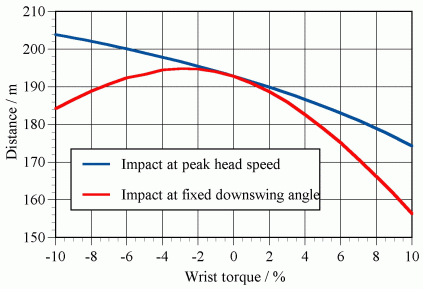 The
chart to the right plots the approximate driving distance versus wrist
torque with almost all other parameters kept the same. Remember that
wrist torque has two effects on clubhead speed. It (a) peaks at a lower
clubhead speed and (b) peaks earlier in the downswing.
The
chart to the right plots the approximate driving distance versus wrist
torque with almost all other parameters kept the same. Remember that
wrist torque has two effects on clubhead speed. It (a) peaks at a lower
clubhead speed and (b) peaks earlier in the downswing.
- The blue curve assumes that the golfer changes his swing so impact still occurs at the peak. We shorten or lengthen the swing so that impact will occur at maximum clubhead speed. This golfer is then only bitten by (a) above.
- The red curve assumes that the golfer simply makes the same length swing no matter what the wrist torque. This golfer is then bitten by both (a) and (b). Negative wrist torque also costs distance because the clubhead speed peaks after impact (i.e., impact is at the black line in the curve above).
This is a very tough lesson, yet all of us have experienced the occasion when we relax, try not to hit a ball too hard, and hit the best drives of our lives. Learn to relax, to shorten your grip, and not to use your hands.
Many people have trouble believing that you do not need to use wrist torque to have an effective golf swing. But to prove a point, some stunt golfers use drivers with a section of rubber tube or dog chain replacing part of the shaft. They still hit the golf ball a long way -- in fact, much the same distance as with a proper shaft. With such a flexible shaft, there is no way that wrist torque can have any effect.
Another good example is the trebuchet shown in a couple of the videos on the next page, a medieval siege machine used to fling rocks into or over castle walls. From the physics point of view, the trebuchet is an upside-down golfer; the raised weight represents the torque applied through the shoulders, the long wooden beam represents the golfer's arms, and the rope sling represents the shaft of the golf club.
Remember that almost all the energy transfer to the club is due to tension in the shaft; the shaft does not need to be stiff, because the vast majority of the force it transmits is along the length of the shaft. If the club had a perfectly flexible shaft -- like the rope sling of a trebuchet -- then there is no way to apply wrist torque to get any action from the clubhead. Yet the trebuchet was a very effective siege weapon. It was the best, most powerful catapult in warfare for centuries until it was replaced by gunpowder-powered cannons, demonstrating that "wrist torque" isn't all that important.
See the videos on the next page for visual demonstrations that a trebuchet can sling things a long way with no "wrist torque" at all.
Summary for Technique
Work done by the golfer builds up kinetic energy in the torso, shoulders, and arms. This is then transferred via tension in the shaft as the club and arms unfold away from the golfer’s body.
- The good: the greater the fold (wrist cock) the more efficient the transfer of energy from the body to the club.
- The bad: the greater the wrist torque (use of the hands) the earlier the club unfolds and the less energy is transferred to the club.
These effects are also counterintuitive – not what the beginner golfer expects. This perhaps explains why a good golf swing is so hard to learn.
Another factor making a good swing hard to learn is that it is mentally difficult to hold onto the club firmly while not holding the wrists firmly. It is curious that most people, when asked to throw a golf club as far as possible, would swing the club around their shoulders without using wrist torque, and this is exactly the action required for a good swing. Swinging a club loosely around your shoulders as if you were about to throw it will help to train your brain to not use your hands. I have also found it helpful to visualise throwing the club through the impact zone. In fact a full vigorous swing around your shoulders like a baseball swing, including hip and shoulder movement, captures all of the important parts of the swing.
One of the benefits of the overlap grip is that it keeps the combined length of the hands short and the right hand weak (for a right-handed golfer). This enables the golfers to grip the club firmly, but limits the ability to apply wrist torque.
Math note
I have not given the full equations for the numerical model here. As I indicated in the introduction, they are too complicated to yield any insights directly – at least not for me. Also, they have to be solved numerically because there is no analytic solution. If you want to experiment with the equations, the full version can be found in Appendix 4 of Jorgensen’s book.
For the analysis here I neglected gravity, assumed constant shoulder torque, and assumed constant wrist torque during the second phase of the downswing. This allows the equations to be partially integrated analytically and reduces the number of dynamic variables in the numerical integration from 4 to 2. For further information see the paper by Pickering and Vickers, or the supplementary EPAPS document associated with my paper – it can be found quickly if you Google EPAPS, golf swing. To do the integrations you will need a moderately good numerical integration algorithm. Applications like Mathcad, Maple, and Mathematica have very good integration routines.
References:
Theodore Jorgensen, "The Physics of Golf 2nd Ed", Springer Verlag, New York, 1994)
W. M. Pickering and G. T. Vickers, “On The Double Pendulum Model Of The Golf Swing”, Sport. Eng., 2, 161-172 (1999)
D R White, "On the efficiency of the golf swing", Am. J. Phys. 74, pp. 1088-1094 (2006)