As with length, there
are both static and
dynamic ways to fit for lie
angle.
As with length, the dynamic methods will just about always get it
right,
but the static methods are quite reliable for a remarkably large
share of the golfing population.
Static lie methods, at least the valid ones, are basically the same
as the static length methods. They size up the golfer for length,
assuming that the clubs will be the "standard" lie
angles.
So let's review the table of "standard men's" lengths and lies
from the previous chapter. The yellow numbers are from the mid-1990s,
when I wrote the first version of these Club Design Notes. Since then,
the usual numbers have changes by quite a bit (though not as much as loft has). Some of the differences:
- Lengths
are longer, typically by 1/2" in the irons and more in the metalwoods.
This can be rationally explained by the prevalence of graphite shafts,
which allow the clubs to be built longer at the same heft.
- Lie
angles are closer together: 1/2 degree per club for most of the set. I
have no rational explanation for this. the length differences are still
1/2 inch, and the relevant geometry hasn't changed since ancient
Greece. (See below to understand what geometry has to do with it.) So I don't have a good explanation.
- The
variation from model to model is greater. In the early 1990s, the 1995
lineup was in almost all the irons you could buy. My table of the 2020
lineup was a consensus number across a bunch of models and
manufacturers, with variations of a degree from the number shown.
But in the final analysis, they are just a set
of numbers; you still have to do a
fitting to get the correct
numbers.
| Club |
1995 |
2020 |
| Length |
Lie |
Length |
Lie |
| 1-wood |
43" |
55° |
45.8" |
58° |
| 3-wood |
42" |
56° |
43" |
56° |
| 5-wood |
41" |
57° |
42.5" |
56.5° |
| 1-iron |
39.5" |
56° |
-- |
-- |
| 2-iron |
39" |
57° |
-- |
-- |
| 3-iron |
38.5" |
58° |
39" |
60° |
| 4-iron |
38" |
59° |
38.5" |
60.5° |
| 5-iron |
37.5" |
60° |
38" |
61° |
| 6-iron |
37" |
61° |
37.5" |
61.5° |
| 7-iron |
36.5" |
62° |
37" |
62° |
| 8-iron |
36" |
63° |
36.5" |
62.5° |
| 9-iron |
35.5" |
64° |
36" |
63° |
| Wedges |
35.5" |
64° |
35.8" |
63.5° |
The rationale for a combined length/lie table like this is a pretty
good one:
- By keeping the lie "standard" and choosing length for your
body
proportions, you are keeping the "standard" (and presumably optimum)
swing plane. You are proportioning your swing to your body. Fallacy:
your ideal club length may not just be dependent on your body
measurements. See the section on length
fitting.
- By keeping the lie "standard", you will be able to use the
generally available components without having to bend them to a custom
lie angle. Fallacy:
length is a more basic fitting element than lie angle. You should
choose the length first, and then get or create the lie angle that
complements it for that golfer's swing.
- If the golfer's swing plane is other than "standard" (or if
other
factors -- like swingweight -- dictate the length), it is an easy
matter
to calculate the change in lie angle
for a change in length.
|
While we're talking about static lie fitting, let's kill
off an
obvious "method" that used to be a lot more popular. It is less popular
now because it has been debunked. I'm talking about having the golfer
set up at address, and adjusting things (properly lie, but some will
adjust length) until the club is 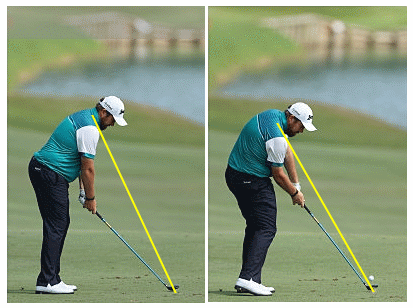 neither toe-up
nor toe-down. No matter
how precise you are about this, you are going to get it wrong. That's
because impact position is not the same as address position; the club
is going to be more toe-down at impact. Two reasons: neither toe-up
nor toe-down. No matter
how precise you are about this, you are going to get it wrong. That's
because impact position is not the same as address position; the club
is going to be more toe-down at impact. Two reasons:
- Because
of the centrifugal force pulling on the clubhead at impact, the hands
are higher and the shoulder-hands-clubhead is more nearly a straight
line at impact than at address. Look at the photo here of Shane Lowry.
Notice how much more upright the shaft is at impact than it was at
address. Lowry is more exaggerated than most in this regard, but all
golfers have it to some degree.
- The shaft will bend more toe-down at impact. This is
called "toe droop" by shaft engineers and clubfitters.
High hands aren't the same amount from one golfer's swing to another's,
nor is toe droop. Thus you can't even apply a correction factor to a
static measure measurement; the factor would have to be distinct to the
golfer.
My assessment is that static lie fitting is ineffective at best, and
more honestly not really fitting at all. |
Dynamic fitting for lie is easier than dynamic fitting for length.
The dynamic lie test is very easy and usually very accurate. In most
good professional fittings, it is the last step of the process before
turning the golfer loose with the clubs. The fitter adjusts the clubs
(usually irons for lie angle (and often loft as well) using a bending
machine.
Tape the soles of the calibration clubs with masking tape.
Place a
piece of thin plywood or masonite on the ground, its surface level with
the ground on which the golfer is standing. Have the golfer take a few
good swings with each club, at a ball located on the center
of the plywood. The effective swings must "clip grass"; that is,
it must strike the plywood so that it marks the masking tape on the
sole.
Now look at where the mark on the masking tape is:
-
If it is right in the middle of the sole (that is, under the sweet
spot),
then that club is the right lie for that golfer at that length.
-
If it is more towards the heel, the club is either too long or too
upright.
-
If it is more towards the toe, the club is either too short or too flat.
That said, you have to be careful that you are reading valid
information from the sole. If the clubface is not square when the sole
impacts the board, then the scuff will not be centered even if the lie
is perfect. But you can tell in a couple of ways.
- The ball flight will hook or slice if the clubface was not
square to the clubhead path.
- The scuff mark will not be in the middle of the sole
front-to-back. If the face was closed, the scuff will be
toward the face (and probably more toward the toe than appropriate for
the lie angle). Conversely, and open face will result in a scuff toward
the back of the sole (as well as toward the heel). I learned this last
one from a Henry-Griffitts fitting manual from around 1990.
So you have a scuff mark. If it is in the middle of the sole, you're
set; the lie is correct for the golfer. But if not, you need
an estimate of what distance on the sole corresponds to what lie angle
error (or length error). This is highly dependent on the shape of the
sole
(especially the amount of rocker, which is heel-toe curvature), and is
probably not a reliable way to
get a final measurement. I have seen soles so curved that 1/12"
corresponded
to a degree of lie, and soles so flat that a degree of lie moved the
mark
over 3/8". But most irons seem to have a sole rocker of 3/16"
to 1/4" per degree.
Example: A valid scuff mark is centered about 3/8" away from the center
of the sole, toward the toe. Since it is toward the toe, it is too
flat; it needs to be bent more upright. If the sole rocker is a
"normal" 1/4" per degree, then 3/8" represents an error of one and a
half degrees. We have to bend the club 1.5° more upright.
Variations
There are variants of dynamic lie fitting. Here are two I am familiar
with:
- Plastic
lie board - This is a very minor change from the method
above. Instead of taping the sole and hitting the ball from a wooden
board, you can use a plastic board designed for the purpose. The "lie
board" is usually black or dark green. Since the plastic is softer than
the sole of the club, some of the pigmented plastic will scrape off the
board onto the club. Instead of looking at a scuffed tape, you are
looking at a dark mark on the sole of the club.
Here's a modification I
made to the lie board I use. The board originally came with an
indentation for the ball about an inch from one end. That's a problem!
If you turn it so the ball is at the target end of the board, the mark
will only show if sole contact is fat, or at least not the proper
divot-after-ball. And if you turn it around the other way, even a
slightly fat hit will send the ball downrange -- or wreck it
altogether. (Don't ask how I know.) I used a drill to make a couple of
indentations in the lie board a third of the way from each end. Much
better!
- Vertical
line on the ball - You don't need a board at all for this;
you can hit off grass or a range mat. Make a straight line on the ball
with a Sharpie or a dry-erase marker. Place the ball so (a) the line is
the first thing the clubface contacts and (b) the line is perfectly
vertical. Hit the ball. An image of the line will transfer to the
clubface. The angle between the line image and the grooves should be
exactly 90° if the lie is correct. If not, you know exactly how much to
correct.
This is a much better method in theory. My problem with it is in
practice. I am very skeptical that you can orient the line perfectly
vertical, only only slightly less skeptical that you can read the angle
between the line and the grooves accurately. Remember every degree of
uncertainty in either of these measurements is a potential lie angle
error of a degree. I'm pretty sure I can't do it freehand; if you can,
more power to you.
- Impromptu
field check - Some shots have a "turf line" on the bottom
of the face, where the turf has been struck making the divot. That can
serve as an extemporaneous check on the lie angle. (Suggestion from
Frank Tracey of Lakewood, CO.) My only concern about this technique is
that, on a well-struck shot, the divot is taken after the ball has been
struck and is on its way. There are lots of things in a swing that
could make the position of the clubface different after impact
than before. Quick example: a high rate-of-closure would mean that the
face is more closed -- and probably toe-down -- than it was at impact.
It is well known that changing the length of the club will change
whether the clubhead at impact is toe-up or toe-down. The lie angle of the club
doesn't change, but the lie
angle error of the fit will be different. There is a trade
between length and effective lie.
|
 Let's start with a
diagram of why
length and
lie trade off. Consider the two length/lie pictures. In each picture,
the hands are at height h,
the
length of the club is c,
and the lie in which the club is being used is angle L.
Note that L
is not necessarily the lie angle of the club; but if the picture
reflects what is happening at impact, it should be the lie
angle of the club. Let's start with a
diagram of why
length and
lie trade off. Consider the two length/lie pictures. In each picture,
the hands are at height h,
the
length of the club is c,
and the lie in which the club is being used is angle L.
Note that L
is not necessarily the lie angle of the club; but if the picture
reflects what is happening at impact, it should be the lie
angle of the club.
It should be clear from this that the club on the left
is a lot more
upright
than the one on the right;
that is, the angle L
is larger. As a result, the shaft c
is longer on the right, because it has to reach further to get to the
ball. If you do the
trigonometry
(I won't ask you to; there are trigonometriphobes in my family, so I
sympathize
with the affliction) you will find that:
- At the sort of lie angles where golf clubs live (53
degrees to 64
degrees)
- Every degree more upright needs roughly 1/2" less
length, and
- Every degree flatter needs roughly 1/2" more length.
So our design rule is pretty simple. The industry-wide "rule of thumb"
is that 1/2" of length trades with 1 degree of lie. That is, if you
make
a club 2 degrees more upright, you can make it 1" shorter and still fit
the golfer that it fit originally. My analysis shows this to be a
pretty
good rule of thumb; it's a little over .5" for a driver and about .3"
for
a wedge or 9-iron, with the rest of the clubs falling somewhere in
between.
This suggests that you can make up for a misfitted lie angle by
lengthening or shortening the club. You can, but it is not a good
idea.
We went to some trouble to find the right length for the golfer. That
is one of the first fitting measures that should be
determined. In a normal fitting, lie angle should be one of
the last things. Bending the clubs to the right lie angle is part of
the fine tuning and testing when the golfer comes in to claim the clubs.
But what if you don't have bending tools: a loft-lie machine and a
bending bar? I was in that position myself the first dozen years of
building clubs. It is a problem, and a difficult one. Here are some
solutions:
- If you only need a small change in length, one that
keeps all clubs within the range of comfortable lengths for the golfer,
then maybe it's OK to use length to tune the lie. But you have to be
very careful here. For instance, you will be affecting heft
(swingweight and moment of inertia) and shaft flex when you make
arbitrary changes to the length. Don't do this unless you really know
what you are doing.
- If only one or two clubs need bending, you can
improvise. I used a big-ol' pipe wrench with padded jaws to do the
bending, and a big woodworking vise to hold the clubhead. Measurement
is also an issue; it is a very important part of any bending operation.
I used a level and a protractor. Today there are much more convenient
tools, such as a Wixey angle gauge, which are not terribly expensive.
(The Wixey is about $20-$30 as of this writing in 2017.)
- You can pay a pro shop to bend your clubs. Before I
got my Scotland loft-lie machine, there was a shop in my area that
charged $4 for each club, and would bend to spec. It's probably more
expensive today, but still a bargain compared to the alternatives.
|
Last modified May 6,
2020
|


