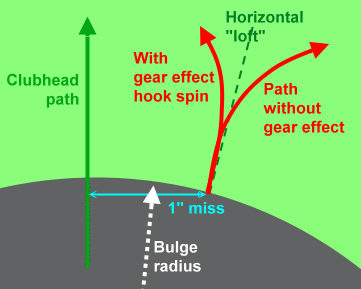
Figure 1-5
Does equation 2a give correct results? We have a way to check this. The
face bulge on a driver is used to counter gear effect; it starts a miss
to the right of center (like the example in our diagrams) out to the
right so the hook spin brings it back towards the center.
Figure 1-5 is a top view of a driver head with an
exaggerated bulge curvature. The hit depicted is a miss 1" toward the
toe. Because of curvature, the ball is struck as if there were a "loft"
in the horizontal as well as the vertical direction. Without any gear
effect, the shot will start right (because of the bulge) and slice even
more to the right (because of the horizontal "loft"). But gear effect
contributes hook spin, with the intent of getting the ball back on-line.
Let's assume that the designers of the driver know what they are doing.
If so, the combination of bulge curvature and gear effect
should result in a much smaller error in the actual drive than the gear effect alone with no bulge
curvature. So let's test our formula against our typical driver. We
will use equation 2a and a 12" bulge radius.
The table below shows how gear effect and bulge counter one
another. The numbers come from:
- Simple trigonometry; e.g. - the "loft" is the arctan of (x
divided by the bulge radius).
- Equation 2a above.
- TrajectoWare
Drive software.
With our ball speed of 150mph, the golfer will hit a typical
well-suited (11°) driver about 240 yards (assuming zero angle of
attack, center impact, etc). So we will look at the side error using an
11° driver. As noted above, we assume a 12" bulge. We use C=1.3" where we need C -- roughly the average value from the Alba tests.
Miss
(how far
towards toe) |
Horizontal
"loft"
due
to bulge |
Horizontal
"launch
angle" |
Slice
spin
due to
bulge |
Hook
spin
due to
gear effect |
Hook
spin
(net) |
Total
side
error |
Hook
without
bulge |
| ¼ |
1.2° |
1.1° |
338 |
553 |
215 |
3 yards
left |
20 yards
left |
| ½" |
2.4° |
2.1° |
676 |
1113 |
437 |
6 yards
left |
38 yards
left |
| 1" |
4.8° |
4.2° |
1354 |
2192 |
838 |
10 yards
left |
61 yards
left |
| 1½" |
7.1° |
6.2° |
2005 |
3294 |
1289 |
11 yards
left |
72 yards
left |
The table shows the steps to computing the total side error
-- the green column. (For more detail on how the computation was done, use this link.)
Compare the green column with the red column, which is the error which is what the error
would have with a flat face, no bulge.
That is a pretty good confirmation
of both the formula and the design of the driver. For each miss -- even
missing the "sweet spot" by an inch and a half, almost off the face --
the total side error is at least six times less than it would have been
without bulge.
The errors due to bulge do a fine job of canceling out the errors due
to gear effect. And they could be even better. A few calculations at a
10½" bulge radius shows very small errors, in the vicinity of a yard. This data strongly suggests that the formula for spin is
sound.
Interesting historical note:
In 1946, a patent was issued
to John Baymiller and Robert Vose of Spalding Golf. It disclosed a
formula relating the optimum bulge radius to the CG depth. The formula
is largely empirical, based on many measurements of real hits with the
wooden clubs then current. For C=1.3", the formula
recommends an optimum bulge of 9½", just an inch less than our
analysis-based optimum seems to be. Bearing in mind that the moment of
inertia of a clubhead was lower in 1946, you would expect the
ideal C to be smaller.
Interesting personal note:
John Baymiller is the father of Bernie Baymiller, a custom clubmaker
and a friend of mine. He gave me a copy of the patent long ago, but I
finally understand it better now.
|