
|
 |
Home ⇒ golf ⇒ biomech ⇒ Current Article |  |
Article
Contents
Physical principles for the golf swing
|
Angular energyJust as we saw that torque was an angular analog of the linear quantity force, there is an angular energy that is an analog of the linear energy. Both work and kinetic energy in the angular domain are calculated as rather obvious analogs of their linear counterparts:Work =
Angular distance * Torque in the direction of that
angle
Kinetic energy = ½ I ω2 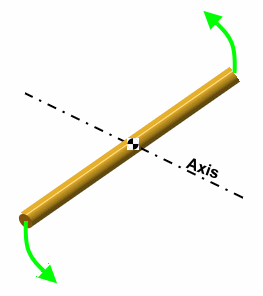 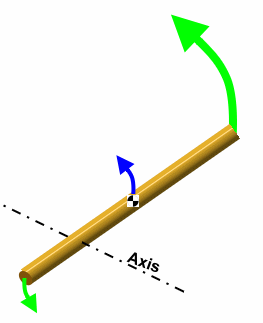 That
isn't hard to understand in the diagram on the left, where the rotation
is about the center of mass. No linear work is done, because the CoM
never moves. Any moment of inertia involved is Io, the inertia
about the CoM. So the calculations are very straightforward. That
isn't hard to understand in the diagram on the left, where the rotation
is about the center of mass. No linear work is done, because the CoM
never moves. Any moment of inertia involved is Io, the inertia
about the CoM. So the calculations are very straightforward.Not so for the diagram on the right. This time, the axis of rotation is not through the CoM, so the CoM is going to move (its mothion is the blue arrow). There had to be an overall force to move the CoM. Remember the equivalent force couple systems? If you understand and remember what happened there, then you realize there has to be a net force in this diagram, because it is providing some linear acceleration to the CoM of the object. Let's solve a problem like this that has a golf flavor. It might provide you some intuition about questions that come up in golf club fitting, though that process is much more complicated than this simple example 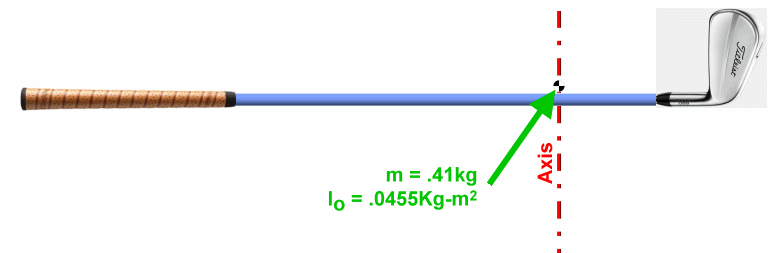
OK, let's move on to the problem: How much work is done by a torque of 0.03 Newton-meters applied at the CoM for 2 seconds? What is the kinetic energy of the club afterwards? The solution First, let's write down the basic stuff we know or can easily compute.
ω = αt = .66 *
2 = 1.32 rad/sec
Θ = ½ α t2 = ½ * .66 * 22 = 1.32 rad ... which happens to be an angle of 75.6 degrees. Now we have everything we need in order to compute work and kinetic energy. Work = ΘT = 1.32 *
.03 = .0396 N-m
KE = ½ I ω2 = ½ * .0455 * 1.322 = .0396 N-m We have answer to the problem, but let's make an important observation. The work applied to the club is exactly equal to the kinetic energy it picked up. That is not a coincidence! One way even the most experience biomechanists check their work is to make sure (if the information is available) that the work done is equal to the useful energy created. (And, if they are not equal, where the rest of that energy went.) Example: WaggleLet's move on to a more interesting version of the same problem. Instead of applying to torque to the center of mass, we apply it where we normally would with our hands -- to the grip.The axis of rotation is now at the mid-hands point. But note, this is not a full swing, just a waggle as shown in the video. For purposes of this example, the major difference between this waggle and a full swing is that the hands, arms, and body never move; the only thing whose energy we care about here is the club itself.Go ahead and try it yourself. Vigorously waggle a proper golf club back and forth, holding the mid-hands point still. No, not a shaft or dowel, a full club with plenty of mass and a CoM near the clubhead. You will find that, in addition to the torque (the hand couple) you must apply, you also have to apply a force to keep the hands in one place. The club wants to rotate around its CoM. If the CoM is far away from the hands, that means the handle end of the club wants to move opposite from the clubhead -- and it takes a force from your hands to prevent that motion. We will see this in more detail below. |
||
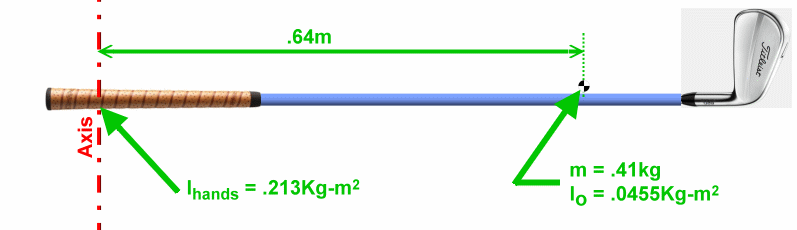 How much work is done by a torque of 0.03 Newton-meters applied at the mid-hands point for 2 seconds? (Note that a force may be needed at the mid-hands point to assure that is the axis of rotation.) What is the kinetic energy of the club afterwards? This works very much like the previous problem, where the axis of rotation was the CoM. The numbers will be different, but the formulas are the same, as is the order in which we use them. Again, let's start with the easy stuff. We need the parallel axis theorem to go from Io (at the CoM) to I (at the mid-hands point).
ω = αt = .141 *
2 = .282 rad/sec
Θ = ½ α t2 = ½ * .141 * 22 = .282 rad ... which happens to be an angle of 16.2 degrees. Now we have everything we need in order to compute work and kinetic energy. Work = ΘT = .282 *
.03 = .0085 N-m
KE = ½ I ω2 = ½ * .213 * .2822 = .0085 N-m Again, the work done by the hands on the club equals the kinetic energy of the club. Or does it?!? We have a couple of linear things to worry about here.
Angular KE
= ½
Io ω2
= ½
* .0455 * .2822
= .0018 N-m
Linear KE = ½ m v2 And we know that, for a spot on a rotating body a distance r from the axis v = rω = .64 * .282 = .18 m/s so Linear KE = ½ m v2 = ½ * .41 * .182 = .0066 N-m Finally Total KE = Angular KE + Linear KE = .0018 + .0066 = .0084 N-m Yes, it comes out the same. (There is a round-off problem in the last digit, but that is all that is wrong.) It took me less than 20 minutes to prove that they will always come out the same, no matter where on the club you place the axis. But I won't bore you with the proof. |
||
Other forms of energySo far, we have talked about work, potential energy, and kinetic energy. Let's look at the other forms of energy we are taught in Physics 101. We'll review them quickly, because they are mostly irrelevant to the study of the golf swing. We'll note where there might be some relevance, and explain it.HeatWhen I think of heat energy, the first thing that comes to my engineering-trained mind is the sort of heat engine that has been the world's most important source of energy for the last century or two. I'm talking here about steam engines, internal combustion engines, and turbines. They power our transportation, and indirectly almost everything else we use. The vast majority of our electric power comes from generators turned by heat engines. All of them have heat as input, and some useful energy as output.But the importance of heat energy in golf is quite the opposite. The heat is output, not input. It is the form of wasted energy, the unusable energy in the golf swing -- and almost all other enterprises that use energy. Let's stop for a moment and define efficiency, because inefficient use of energy is exactly where that heat comes from. Efficiency is:
For example, it you only get out half the energy you put in, the efficiency is 50%. (In golf and most technologies, there are other metrics that they call "efficiency". For instance, I have seen clubhead speed divided by the maximum possible clubhead speed called "speed efficiency" of a swing. But, strictly speaking, efficiency really refers to the useful energy you get divided by the total energy you supply.) But we know that energy is conserved; it can not be created nor destroyed. So the missing energy has to go somewhere. And it almost always manifests itself as heat energy; something in the system gets a little warmer, heated by this "lost" energy. |
||
FrictionIn golf analysis, the lost energy is always heat, and usually due to friction. We know that friction can supply heat; think about starting a fire by rubbing sticks together. Maybe it doesn't supply a lot of heat; it takes a lot of effort to start a fire that way. But have you ever gotten a rope burn, when a rope you are holding "runs away" in your grasp. There's a pretty dramatic example of friction work turning into heat energy.So how does friction work? At a "hand waving" level, something sliding across another surface is acted on by a force that resists its sliding. But let's be a little more precise. 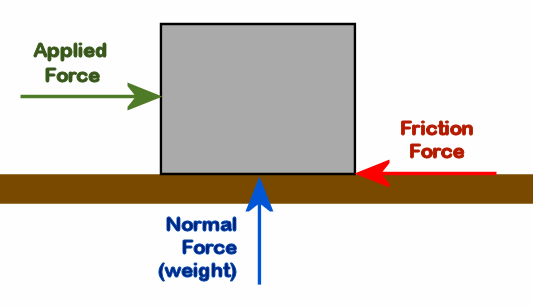 The diagram shows a block resting on
the floor. The diagram shows a block resting on
the floor.
Just in case it isn't clear yet, here's how it works. In the following, A is the applied force, F is the friction force, and N is the normal force.
|
||
|
||
ChemicalA small corner of chemical energy is at the core of biomechanics. The body burns nutrients to power the muscles. Our entire body is maintained by such chemical energy. However, it isn't part of the physics of the golf swing, and this tutorial is going to ignore it. Nutritionists and exercise scientists get deeply involved in chemical energy and the processes related to it. If you go on to do college degree work in biomechanics, I'm sure you will get plenty of exposure to this branch of the science. For our purposes, we are going to view muscles as engineers would; they are actuators with specifications and limitations. We'll get into that in the next chapter. |
||
ElectromagneticElectromagnetic energy is a very important practical branch of the study of physics and engineering. It includes:
|
||
NuclearWe do not have to worry about nuclear energy nor quantum mechanics in golf physics. Period! If anyone tells you otherwise, they need to have their heads examined -- or at least get a clue about physics. I only mention this because an otherwise knowledgeable golf expert once insisted to me that quantum effects are important in putting. Actually they were expert in tournament golf, not golf phsyics -- and it showed. |
Last
modified -- Dec 3, 2022
|
|
|