 The simplest model that makes any sense at all for the golf swing is a double pendulum. The two members of the pendulum are:
- The golfer's shoulders and arms, taken as a single rigid unit. That's the green triangle in the diagram. We'll call that "the triangle" in the discussion that follows.
- The golf club, also taken as a single rigid unit.
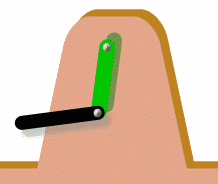 This
is a very simple model, having only two moving elements hinged
together. To see just how simple, let's re-draw it the way an engineer
would: as a collection of free, hinged bodies. Now we can see why the
model is a double pendulum; it is a black pendulum (the club) hanging
from the end of a green pendulum (representing the triangle). While the
diagram looks different from the golfer above, it works exactly the
same when it comes to physics.
This
is a very simple model, having only two moving elements hinged
together. To see just how simple, let's re-draw it the way an engineer
would: as a collection of free, hinged bodies. Now we can see why the
model is a double pendulum; it is a black pendulum (the club) hanging
from the end of a green pendulum (representing the triangle). While the
diagram looks different from the golfer above, it works exactly the
same when it comes to physics.Given the simplicity of the model, it's pretty amazing how close it can get to the actual measured performance of a golfer's swing. True, there are a lot of nuances of the swing that it doesn't capture. But experience has shown it is rich enough to explain where the clubhead speed comes from in a good swing.

Let's look at the next question about using the model. We have two hinges, and we can apply a torque at each of those hinges. Those two torques -- plus gravity -- are the only forces in this model that will cause the golfer to swing the club.
So the engineering model has to say what kind of torque:
- The body applies to the shoulders to turn the triangle.
- The hands and wrists apply to the club to uncock it and bring it to impact.

The answer is centrifugal force.[1] Remember that a body in motion wants to keep moving in a straight line. But the golfer is pulling the club around in a circle. According to Newton, the club wants to fly outward from the circle; the force that is trying to pull it out straight with the arms is centrifugal force. That centrifugal force is generated by pulling the club in a circle around the shoulder hinge, and the force wants to pull the club straight out along a radius from that hinge.
How big is that centrifugal force? Let's look again at the formula:
m v2The mass m is a property of the golf club, and the radius r is a combination of the extended arms and the wrist-cock angle. The more acute the wrist-cock angle, the closer the club is to the shoulder hinge -- and thus the smaller the radius. As for velocity v, it increases as the body torque accelerates the triangle.
F = ------
r
So, what does the golfer have to do to get maximum centrifugal force in order to get maximum clubhead speed? His job is to "hold the lag" -- keep the club cocked at a right angle to the arms -- until fairly late in the downswing. This keeps from releasing the club until v is nearly as large as it's going to get, which allows a large F to accelerate the club outward and downward just before impact. This, and not torque applied by the hands, is the way to reliable high clubhead speed.
(It is worth noting there is criticism of centrifugal force as the mechanism of the golf swing. More on that here.)
 He
couldn't do it with the simple double pendulum, so he added complexity
a little at a time until he had an exact match between the mathematical
model and the golfer's swing.
He
couldn't do it with the simple double pendulum, so he added complexity
a little at a time until he had an exact match between the mathematical
model and the golfer's swing.