
|
 |
Home ⇒ golf ⇒ swing ⇒ Current Article |  |
Article
Contents
Modeling the Swing - Executive Summary
Dave Tutelman
-- January 16, 2012
|
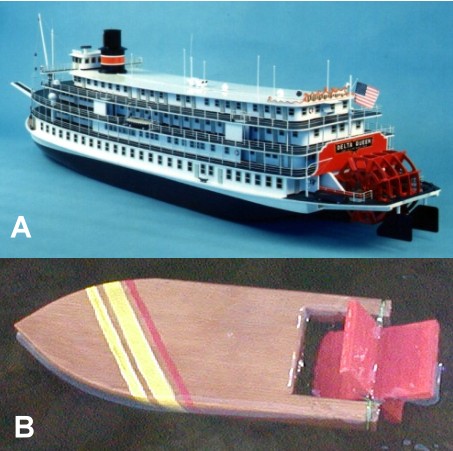 The picture
at the right shows two models of a
rear-paddle-wheel boat. Which one is better? The picture
at the right shows two models of a
rear-paddle-wheel boat. Which one is better?The answer: It depends! Specifically, it depends what you want to do with the model.
B is a working model. The objective is to use it to mimic the operation of a paddle-wheeler. Why mimic the operation? There are a couple of reasons to want to. The boat in the picture is a toy; it is fun to play with working model boats. But you can also use the model to learn about paddle-wheeler operation. Let's look at the second motive: learning from the model. Suppose you want to learn how a paddle-wheeler works, and what changes might make it work better. Then you want a model that contains the important elements that you want to investigate, but it doesn't need to contain any more elements. If the goal is to relate paddle speed to boat speed, you need a paddle and hull of the appropriate shape and weight -- and that is all. It doesn't matter how many windows the boat has on each deck, or whether there is a pilot house or smokestack; those features of a model are completely irrelevant to the purpose. Moreover, they are expensive to include in the model, and may even get in the way of the researcher. Important point: there is a third kind of model, whose only purpose is for learning about operation. C is a mathematical model. If you come up with a bare-minimum-simple working model (say, model B without the racing stripes), you probably have a system simple enough that it can be described by equations well known to physicists and engineers. At that point, you don't have to get your hands wet to answer the questions a working model could answer; you can let a computer crank through the equations and answer the questions for you. |
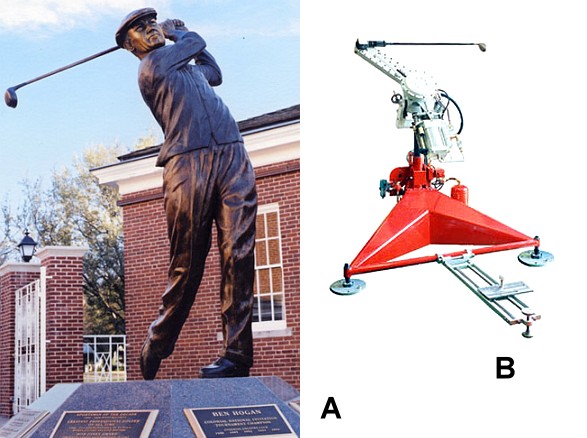 Now, just
to see if you've been paying attention, at the left are two models of a
golf swing. Which one is better? Now, just
to see if you've been paying attention, at the left are two models of a
golf swing. Which one is better?The answer is the same as above, and for all the same reasons. That goes for (A) the scale model, (B) the working model, and (C) the mathematical model (not in the picture). In this article, we are tracing the most important developments (in my opinion, of course) in models of the golf swing. In each case, there is a mathematical model; there may also be a physical working model to demonstrate the principles. We will look at swing models starting with the simplest (the double pendulum model), and work towards more complex models. Each of the models answers some questions about the golf swing, but the model does not include the detail to answer other questions. For instance, even the full-body model -- which simulates 14 joints -- cannot address which fingers should be the "pressure points" for the swing; individual fingers are more detail than the model contains. Let's finish this introduction to models by reminding ourselves what a swing model is NOT: A swing model is not the same as a model swing! When most people hear "model swing", they think of a perfect swing, one to be emulated when making your own swing. That is a correct interpretation, but it is not what a "swing model" is about. A swing model is a simplified representation of a swing (either mechanical or mathematical) that you can "play with" to learn more about what works in a golf swing and what doesn't. A swing model is not an actual, human golf swing! This should go without saying, but too often it doesn't. A model is a simplification of a golf swing. In any simplification, details are left out. Those details may be important or not, depending on what questions we are trying to answer using the model. For instance, the Iron Byron -- the swing robot in picture B -- teaches us a lot about the left arm, the wrists, and the shoulder turn. But it does not teach us anything about how the torso or hips or legs create the body rotation, just what the body rotation does to the arms and club. You need a model that has a representation of torso, hips, and legs to answer that question. |
Lessons from the models
Here is a simple description of each of the models, and the lessons to be learned from the model. For details about a model or a lesson, click on the button next to it. You can use this summary in at least three ways:
- Just read it and assume you know what the article says. (You'll probably be wrong about that, but you'll know where to turn when you really need to know.)
- Use it as a table of contents, so you can dive into the specific lessons you find of interest.
- Use it as an introduction to tell you what to expect, then
go
ahead and read the whole article.
| Model |
Lessons |
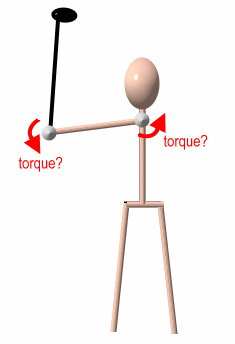 Double
Pendulum Double
PendulumTwo rigid pendulum members. The inner member represents the golfer's straight left arm, and the outer represents the club. A torque (which can be a function of time) may be applied at each of the pivot joints. All hinging is done in the same plane, so the model is two-dimensional. |
Increasing the initial
wrist cock angle
significantly increases the clubhead speed at impact. |
| Increasing the initial
shoulder turn only
increases clubhead speed at impact by a little. |
|
| Increasing
the strength of the shoulder torque (the torque representing body
rotation) increases the clubhead speed at impact, though not in
proportion to the increase in torque. |
|
| Increasing
the initial shoulder turn allows a more complete release of the wrist
cock. Increasing it too much ("overswinging") turns this release into a
cupped wrist. |
|
| The
longer into the downswing you maintain a large wrist cock ("clubhead
lag"), the more the clubhead speed at impact. This is the
most
important lesson from the double pendulum, and leads to the surprising
result... |
|
| Simply
allowing the wrists to hinge effortlessly gives a higher clubhead speed
at impact than does applying wrist torque to help release. |
|
| Gravity accounts for about
8% of the
clubhead speed at impact. |
|
| We
lose something important by holding the inner pivot in a fixed
position. If we approximate the movement of the left shoulder by
shifting the pivot forward during the downswing, we gain about 9%
more clubhead speed at impact. |
|
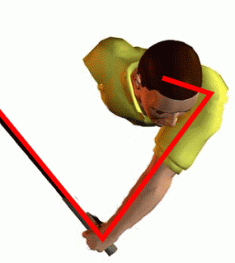 Three-Dimensional Triple
Pendulum Three-Dimensional Triple
PendulumAdded to the double pendulum model is a third element, a shoulder. It is another member, from the spine at the base of the neck to the shoulder joint. In addition, this model is no longer restricted to two dimensions. The axis of the spine pivot and the axis of the shoulder joint are not in the same plane. In addition, the left-arm member can rotate around its own axis. So, instead of two torques there are four, and none of those four axes are parallel to another. |
In
a good swing, the club releases from the inside out: first torso turn,
then the arm moves away from the chest, then the wrist uncocks. As a
consequence... |
| Clubhead lag is a major
factor in clubhead
speed, just as we learned with the double pendulum model. |
|
| A "blip" of wrist torque
at the correct
moment will increase the
clubhead speed at impact. But most of the work is done by torso and
shoulder torque,
and very little wrist torque is employed for most of a proper downswing. |
|
| The
angle of the clubface to the target plane (clubface squaring) roughly
tracks
the wrist cock angle. That is, the clubface lies in the target plane
early in the downswing while the wrist cock is about 90º; at impact,
the wrist cock is 0º and the clubface is perpendicular to the target
plane. In between, they track closely enough to use for approximate
studies. |
|
| Even the best swings are
pretty far from a
single plane. The plane of the left arm varies by 25º
over the course of the downswing, for MacKenzie's optimized model.
Similar variations are observed in other studies that MacKenzie cites. |
|
| The right arm "pistoning"
(right elbow in
extension) helps to create maximum distance. |
|
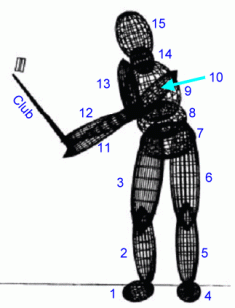 Full-Body Model Full-Body ModelA model with 16 elements (if you include the golf club) and 14 joints. Each joint is a ball joint that can turn in three dimensions. Torques are applied to the joints, and "tuned" until the motion of the model matches that of a good golfer. (Or a not-so-good golfer; that is one way to look at the model's output and see what the good golfer does differently from the high handicapper.) While this is much closer to a working scale model than the others, its complexity taxes both the computer's abilities to simulate it and the researcher's abilities to properly formulate questions of the model. |
In
the best swings, the lion's share of the work is done by the right hip,
the muscles in the lumbar region, and the muscles in the thorax. The
next most important muscles are those driving the left hip and
extending the right elbow. The other muscles play a relatively small
role; in fact, the left ankle and left knee add nothing. |
| In
the best swings, the work starts at the bottom and works its way up:
first ankles, then knees, hips, lumbar, thorax, and shoulders in that
order. |
|
| On
a finer grain level, the left side fires before the right side. That
is, the left knee before the right knee, the left hip before the right
hip, etc. |
|
| When
things get to the arms (that is, wrist and elbow joints), the sequence
seems to make less difference. All four of these joints peak in the
last 15 milliseconds of the swing -- almost simultaneously and almost
at impact. |
|
| Wrist cock is vital to
clubhead speed. The
clubhead speed with a good wrist cock is 40-70% higher than with no
wrist cock. |
|
| A good swing just allows
the wrists to
uncock, rather rather than encouraging the uncock using wrist torque.
In fact, by
the time impact is reached, the wrists cannot keep up with the
rotational speed of the club. |
|
| Better
golfers enhance centrifugal release by controlling the path of their
hands -- specifically, the curvature of that path. Their hands move
more in a straight line early in the downswing, and a tighter curve
just before impact. |
|
| Exercise programs for golf
should focus on
flexibility, not just strength. |
Notes:
- Of course
there are counterexamples, working
scale models. For instance, model railroading is a hobby where accuracy
of both appearance and operation is important. But that is not what we
are talking about here.
Last
modified -- March 6, 2012
|
|
|