
|
 |
Home ⇒ golf ⇒ biomech ⇒ Current Article |  |
Article
Contents
Physical principles for the golf swing
|
| Sorry,
but I cringe when I hear a golf instructor use the word "leverage". It
is almost always used wrong, or at least opposite to how a physicist or
engineer would use it. It isn't just wrong terminology, though it is
certainly that. It usually gets the physics wrong as well. First let's see where that misuse of the word comes from, then we'll figure out why it is wrong. What golf instructors too often mean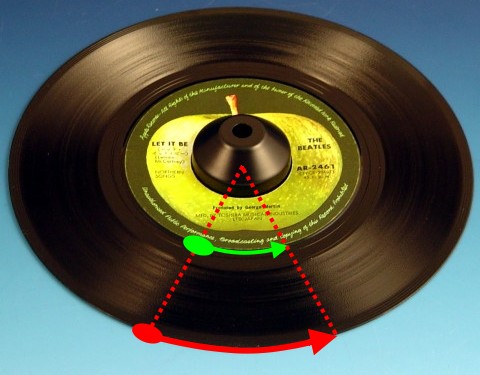 Here
is a picture of a record on a
turntable. (I understand this formerly obsolete form of music recording
is coming back. So maybe some of you youngster may recognize the
picture.) Take a look at the green spot on the recording. As the
record rotates from one dotted line to the other, the spot traces out
the path of the green arrow. Here
is a picture of a record on a
turntable. (I understand this formerly obsolete form of music recording
is coming back. So maybe some of you youngster may recognize the
picture.) Take a look at the green spot on the recording. As the
record rotates from one dotted line to the other, the spot traces out
the path of the green arrow.The red spot is further from the axis of rotation, which is the center of the disk. As the rotation traces out the same angle, the red spot has to move farther. So, in the same period of time, the red dot travels farther than the green spot. In other words, the red spot is moving faster than the green spot. Put in the terms we use in biomechanics: For the same angular velocity, the longer the
distance from the axis,
the larger the linear velocity.
Now comes the great leap of language. Let's call the distance from the
axis to the spot in question a "lever". (I'm being facetious. It is not a
lever. But that is the mental analogy that leads to the error in
terminology.) With this creative use of verbiage, the statement becomes The Leverage Myth.The longer the lever arm, the faster the end
of the arm will travel.
Note
that this is a statement about geometry/kinematics. It is not a
statement about phyics/kinetics. And "lever" is a physics and
engineering term. "Lever"
refers to how forces and torques relate to one another. It isn't really intended to be
about how angular velocities relate to linear velocities. |
||||||||||||||||||||||||||||||||||||||||||
The fallacy of the "whoosh drill"Where does this impression -- that the longer the lever arm, the faster the end of the arm will travel -- come from? How did so many mainstream golf instructors manage to assimilate that piece of misinformation. (Well, I haven't shown it to be misinformation yet. I will.) Let me take a guess at the sort of experience that would lead one to such an assumption. There
is a popular and useful drill that many golf instructors use, the
"whoosh drill", for
increasing your clubhead speed. Note that I'm not disagreeing with the
drill as a way to demonstrate increased speed. My problem is with a
misconception that the drill engenders, a misconception that feeds the
wrong assumption that "a longer lever will result in a higher speed".
If you look around on YouTube, you can see examples of the drill being
demonstrated by widely known
and respected instructors like Erika
Larkin, Piers Ward, GOLFTEC,
etc. There
is a popular and useful drill that many golf instructors use, the
"whoosh drill", for
increasing your clubhead speed. Note that I'm not disagreeing with the
drill as a way to demonstrate increased speed. My problem is with a
misconception that the drill engenders, a misconception that feeds the
wrong assumption that "a longer lever will result in a higher speed".
If you look around on YouTube, you can see examples of the drill being
demonstrated by widely known
and respected instructors like Erika
Larkin, Piers Ward, GOLFTEC,
etc.The essence of the drill is to grip the club upside down, near the clubhead, and swing it as if the butt were the "business end". It is much easier to get plenty of angular velocity that way, and gives the golfer the experience of speed. If you want to understand why it's so much easier to develop speed using this drill, think about the moment of inertia when you hold the club this way. The axis at the hands is rather close to the center of mass of the club, so the moment of inertia of the club is close to Io. Remember when we calculated Io of a 7-iron as 70,600 gram-inches? Let's see what the moment of inertia is for the same club at the mid-hands point. We will use the same parallel-axis theorem we used before.
That is almost 5 times the moment of inertia you feel when you grip the club for the whoosh drill. For the drill, it feels like there is no resistance at all to rotating the club -- and indeed that is the whole point of the drill. But if you get to believing this is the normal thing, that you can let a "lever arm" get longer and still have the same [negligible] rotational resistance, then:
|
||||||||||||||||||||||||||||||||||||||||||
Leverage in the real worldForce multiplierIn the real world, a wrench is one of the most classic examples of a lever, so let's look again at a wrench. No new information here, just a look at what we already know -- but with the "leverage myth" in mind. T = r*F
The moment arm r
is a force
amplifier
in that the longer the arm the more torque you can get from a given
force. This is the origin of the famous quote from Archimedes, “Give me
a place to stand, and a lever long enough, and I will move the world.”
Hey, the ancient Greeks understood leverage more than 2000 years ago.Now let's look at the same wrench, and the same controlling equation, from the point of view of the leverage myth. Now the force is no longer the input; the torque is the input -- rotating something at its axis -- and the output is motion at a distance from the axis. All is well and good as long as whatever you are moving has no resistance to motion. But that is clearly not the real world. Real things -- clubheads, golfers' arms, golf balls, etc -- have mass that resists being accelerated. Remember F=ma. So we have to look at how much force is available to us to accelerate whatever "payload" we are trying to move at some high speed. (For the golf instruction discussion, the payload is usually a clubhead or the hands.) The equation, once again, is T=r*F. But this time the input is torque, not force, so let's solve the equation to see what force is available to us. F = T/r
This says the longer the arm, the less force
we can bring to bear on accelerating the payload. So the leverage myth
is fine as long as we are not trying to get anything real to move fast.
As soon as the target of our speed has noticeable mass, things seem to
go in the opposite direction -- a
longer lever provides less force to accelerate the mass. Let's
take a closer look, and see whether
things get better or worse.Length vs moment of inertiaIn the real world, and in fact in the golf swing, longer does not necessarily mean faster. It does occasionally but not in most cases, and often longer actually means slower. Let's look at a simple case, rotating a rod about its end.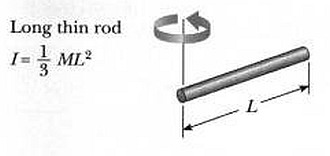 Here is an entry from a table of moments of inertia
of common shapes. It is a rod being whipped around an axis
perpendicular to the rod's own axis. If the interpretation of leverage
given above is correct, then a given torque on the axis should
accelerate the end of the rod to higher speeds the longer the length of
the rod is. Let's check out that assertion. Here is an entry from a table of moments of inertia
of common shapes. It is a rod being whipped around an axis
perpendicular to the rod's own axis. If the interpretation of leverage
given above is correct, then a given torque on the axis should
accelerate the end of the rod to higher speeds the longer the length of
the rod is. Let's check out that assertion.We know that T=I*α, so therefore α=T/I. Let's substitute for I the formula we see in the diagram.
So the angular acceleration goes down with the square of the length. The rotational speed is hurt by length in the real world. But the leverage myth talks about the linear acceleration of the endpoint. Has the angular acceleration been hurt enough so the myth is not true? We know that linear acceleration is related to angular acceleration by a=rα. Let's see what happens to linear acceleration, where r is the length of the rod L.
We see that the linear acceleration is inversely proportional to the length of the rod. Implications:
|
||||||||||||||||||||||||||||||||||||||||||
But wait!
It's
even worse than this in the real world. What happens when you lengthen a
rod in the real world? Does it stay the same mass? In the diagram: What happens when you lengthen a
rod in the real world? Does it stay the same mass? In the diagram:
|
||||||||||||||||||||||||||||||||||||||||||
ConclusionThe leverage myth believed by a lot of instructors is not only false, in reality it is often backwards.In the real world, anything you want to move has mass. If you move it angularly, it has a moment of inertia. When you take this into account and reflect increased moment of inertia as you increase length, there is no speed gain and in fact speed may suffer. For some detailed looks at how the leverage myth fares in an actual golf swing, check out my article on why tall golfers statistically hit it farther. When the question came up in a golf instruction forum, a lot of instructors cited the "leverage" of longer arms and legs, or greater height. But the actual explanation is very different. In most cases, the longer arms hurt rather than helping. |
||||||||||||||||||||||||||||||||||||||||||
Math note: Proof that longer does not equal fasterLet's stick with the optimistic assumption that the length of the rod (in this case the golf shaft) does not get any heavier with length. This is contrary to fact, but let's just say that the assumption favors the myth. If the myth is shown here to be wrong, it is even more certainly wrong with a more realistic assumption. Our object is a simplification
of a golf club, with length L, shaft mass S, and clubhead
mass H. The specific assumptions we make
for ease of analysis include: Our object is a simplification
of a golf club, with length L, shaft mass S, and clubhead
mass H. The specific assumptions we make
for ease of analysis include:
Let's do it! 1. Moment of inertia It's the moments of inertia of the shaft and the clubhead added together. Ishaft = SL2/3
Ihead = HL2 I = Ishaft + Ihead = L2(H + S/3) Let's call H+S/3 the "equivalent mass", and denote it as M. So I = ML2
2. Angular acceleration We know that angular acceleration α=T/I and now we know I. So:
3. Angular velocity Integrate α to get angular velocity ω.
4. Angular displacement Integrate ω to get angular displacement Θ.
5. Time at which Θ=3π/2 From the results of our integration:
Plug in Θ=3π/2
Solve this for t.
6. Linear velocity at that time We can start by finding the angular velocity for that time. In step #3 above, we derived the angular velocity ω as a function of time t. Now we know the value of t, so let's plug it in.
Let's apply V=ωL, which gives us
Note that the Ls canceled out, so there is no L in the formula for V. This tells us that increased length does not give us any more clubhead speed if we are simply rotating the club with a fixed torque. The leverage myth is not true. And that is before additional realities like longer shafts being heavier kick in. When that happens, increased length is a detriment to clubhead speed. Note that this is not a model of a golf swing. It is a simple rotation of the club about an axis at the butt. The actual swing is more complex. Sometimes a longer "lever arm" helps and sometimes it hurts. |
Last
modified -- Oct 2, 2022
|
|
|