Exercise for older golfers
Core exercises
Dave Tutelman -- October 20, 2013
I am not an exercise professional. I am sharing these exercises with
you because they have done good things for me and may do good things
for you. But you do them at your own risk. Ease into them, so you don't
do something silly and hurt yourself. Any
exercise can aggravate an existing injury, or possibly even cause an
injury if you do it wrong.
The safest approach is to be evaluated by a trained exercise specialist
(physical therapist, personal trainer, TPI, something like that) before
you start a back exercise program. I have been doing these exercises
for over 20 years, I was a lot younger and stronger when I started, and
I am used to them. They may not be right for you, but an exercise
professional can prescribe exercises that are for you.
At age 45, my back started to give me trouble. About once a year after that, I
would do something to throw my back out, and it would take
two weeks for me to feel good enough for golf or volleyball or
bicycling (my top three sports at that time). This went on for five
years, when I got an even worse back attack. It showed no signs of
getting
better after three weeks, so I went to a doctor with it. The diagnosis
was sciatica.
The prescription was six sessions of physical therapy. (Back
specialists almost always start with physical therapy; if that doesn't
work, they will turn to something more aggressive, like medication,
shots, or surgery. But trying physical therapy first makes a lot of
sense.)
The physical therapist quickly sized me up as someone who does exercise
and understands it. He told me that I would only need one session --
that he would teach me all the exercises that I would need, and I was
on my own to do them.
I set myself a schedule, stuck to it, and the problem that wouldn't go
away was gone in less than a week.
But it didn't end there. That is
critical!
I continued to do the exercises as a preventive measure. I read books
on back treatment and back exercise. I boiled my "back maintenance
program" down to six body core exercises that I do four mornings a week. I do
them religiously. Hey, it takes less than five minutes total. I do it
every -- every! -- Tuesday,
Thursday, Saturday, and Sunday. I do not skip days just because I don't
feel like exercising. I do it in a fixed place among "the three 'S's".
I
have made it a routine that I do not depart from. I have found that
doing them at least every second day is critical to my back's comfort.
That was more than twenty years ago. Since then, I have only had two
back attacks worth mentioning (that is, they lasted more than a day or
two).
- The first turned out to be more mental than physical. A problem
at work
was keeping me tense. Once I realized it, I dealt with the problem at work; the
back pain
was gone the next day.
- The
other problem was more serious and definitely physical. My
doctor wanted an MRI. When I came back with the MRI images, she looked
at them and asked how I had managed to walk into her office. I had a disk
problem so severe that only my back health due to the
exercises was keeping me from being crippled by the pain. A back pain
specialist gave me a cortisone epidural shot, and it got me
back to normal. That was more than six years ago, and no recurrence so
far.
I credit my better back health (and better and more lasting response to
treatment) to my regularity with this simple, quick set of core
exercises.
Here are my exercises, in the order I do them. They include both
strength and stretching exercises. The strength training is balanced
all the way around the body's core: the back muscles, the abs in front,
and the obliques on the sides. Even if you don't have back pain and
don't feel you need the "preventive maintenance", this is also a good
set of core exercises to supplement the weight training on a previous page.
Abdominals
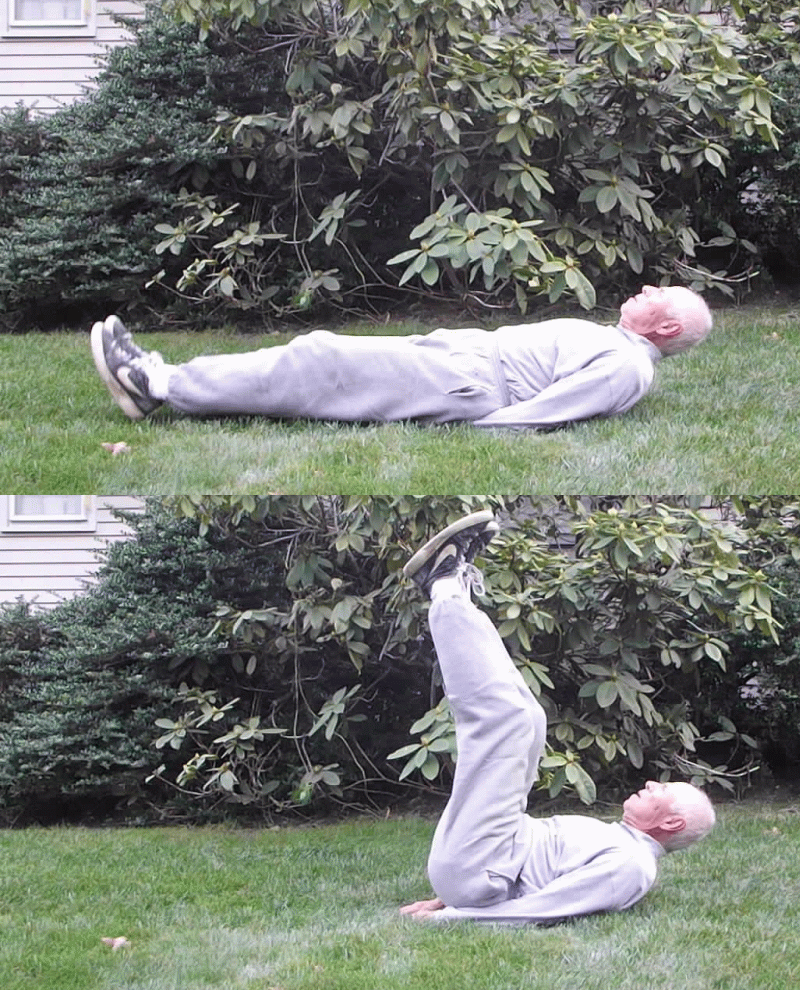
I start with the abs. The physical therapist impressed on me that it
was important to balance the effort on all sides of the spine, the
muscles behind the spine were not enough. I use the leg lifts shown
here, but any good ab workout will do -- as long as I do it at least
every other day. Over the years, I have also used sit-ups and crunches.
I find the leg lifts are most effective for me; YMMV. Meryl Freeman
advised me to keep my head on the ground; I have incorporated that into
my routine -- though not the photo here.
I do a set of sixteen leg lifts.
|
Twist Stretch
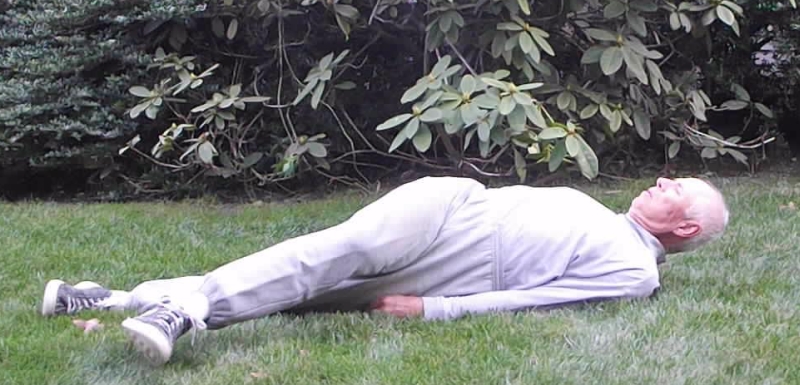
Keeping both shoulder blades on the floor, try to touch the ground with
your right foot -- on the left side of your body. In order to do this,
your torso must twist 90º between the shoulders and the hips. This
stretches the back's ability to twist, obviously important for a
golfer. (But apparently important for everyone. The physical therapist
prescribed it without knowing I was a golfer, and most back care books
do include this
exercise.) Again, Meryl has convinced me to keep my head on the ground
-- not yet in the photo here.
Repeat with the left leg on the right side of the body.
|
Back Strength (Single)
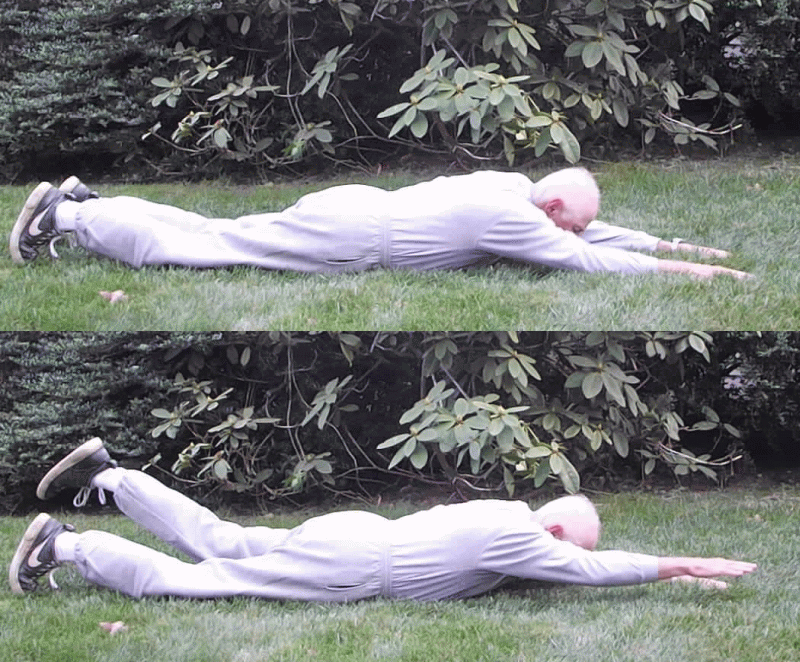
Lying on your belly, raise your right arm and left leg simultaneously.
Use
your back muscles to do the lift; get the thigh and the whole arm off
the deck. (Meryl Freeman tells me this exercise is called "Superman" --
for obvious reasons.)
Repeat with the left arm and right leg.
I do twelve on each side.
|
Back Strength (Double)
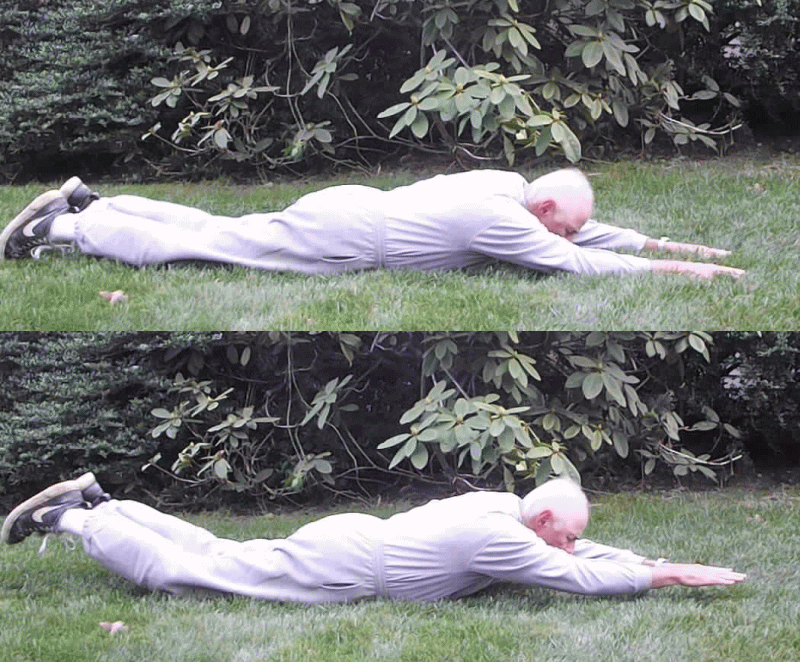
Just like the single above, but both legs and both arms simultaneously.
Much harder. You won't get them nearly as far off the ground. But it's
the effort that counts.
I do a set of ten.
John Taylor has suggested
that the double superman exercise places too much compression on the lower vertebrae,
and Meryl also expressed reservations about how many 70-year-olds could
do this. John suggested a "bird
dog" exercise
in its place. There are plenty of other back strengthening exercises in books and on the Internet.
If you don't find one that helps you, see a physical therapist for a
"custom fitting".
Update Dec 2016
It
turns out John and Meryl were right. After age 75, I had trouble
getting through this exercise. My doctor prescribed a month of physical
therapy in November, and the therapist wanted supermans but not double
supermans. So I dropped the exercise from my core routine.
|
Obliques
I didn't get this one from the physical therapist, but doing it makes a
lot of sense. If you want to surround the spine with strong muscles,
the obliques are on the sides of the lower back and should be
exercised. (In addition, the obliques play a significant role in the
golf swing, so a golfer should be doubly interested in keeping them
exercised.)
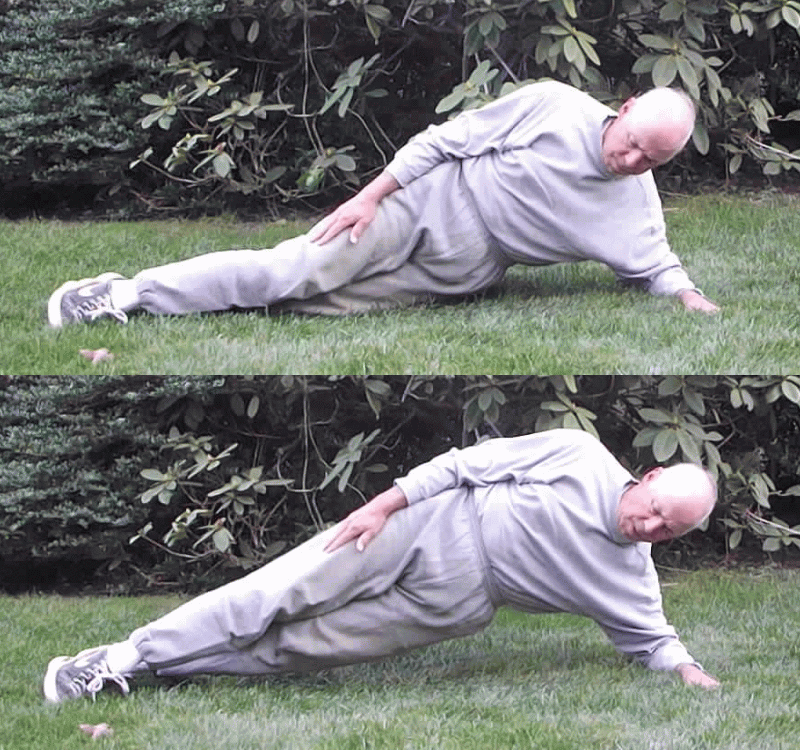
Exercise books call this a "side plank".
Turn onto your side, specifically your left hip, and raise your upper
body so it is resting on your left elbow. Use the muscles in your left
side to pull the hips up, until the body is a straight
line (slanted, but straight) from feet to head. This exercises the muscles on the left side of
the body, especially the left obliques.
Turn over and do the same thing for the right side.
I do twelve on each side.
Update Dec 2016
Sciatica is providing a lot of pain when I do this exercise. So I have replaced it with side leg lifts, which were recommended to me by the physical therapist.
|
Lordosis Stretch
The backwards curve of the lower spine is called "lordosis". A common
problem with people who have back problems is maintaining lordosis --
maintaining the curvature. This stretch is to make lordosis more
natural for a back-troubled body.
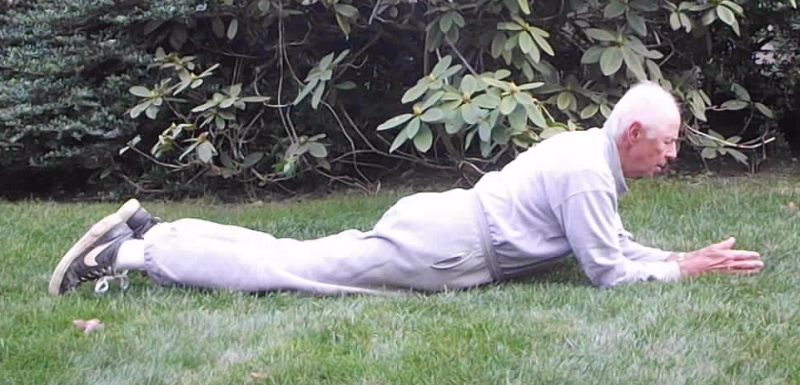
Lie on your belly. Raise your shoulders up on both elbows, being sure to keep your hips solidly on
the ground.
It will feel strange at first, perhaps even painful, but keep at it. As
you find it easier, push your neck even higher using your shoulders.
Crank in as much lordosis as your body can handle. It will become more
comfortable with time, and is an important exercise for the back.
I use this exercise, not only to finish off my back exercises and relax
my back before moving on to other activities, but to make my back feel
better when it starts getting tight or painful. I have been known
to "assume the position" when getting out of my car after a long drive.
Even the touring pros know this one -- though
you'll often see them doing it standing up. If you see a golf pro on TV
standing with his hand behind his hips and pushing his hips forward, he
is doing a lordosis exercise.
|
Some additional points:
- You don't need a gym or a mat for the back exercises. I do them
on a
carpeted
floor. They work just fine in carpeted hotel rooms and cruise ship
cabins. It was a little harder on the lawn, where these pictures were
taken. I have never been in a situation that was a good excuse for
slacking, except when I was in the middle of a back attack. Which
brings me to...
- When I have a back attack, there is always the temptation not to
push things. "Let's skip the exercise until this goes away." Bad idea!
The stretches (if not the strength exercises) can and should be done
several times a day to keep the back in shape and limber. It may hurt a
bit the first time I do the stretch, but I find it makes the
back feel better faster -- even the same day. I add the strength
exercises when I can without too much pain. Again, it definitely speeds
up healing, and prevents it from turning into a full-blown, weeks-long
back attack.
- My routine is a minimalist workout, just one set of each
exercise. I'm sure two or three sets would be even better, but... I
don't trust myself not to be a slacker. I need an exercise routine that
is short enough so there is no
possible excuse not to do it every time the schedule calls for
it. This one works for me, and it has improved my back health really
remarkably.
- When you first start out with back exercises, you may want to be
even more minimal. Do only the exercises you can, and don't hurt yourself with
too many reps. Build up so you feel a good ache, not a damaging pain.
Last modified 7/20/2014
|