What and WhyLet's start by looking at Lee Comeaux himself demonstrating the swing. Lee is a big guy and a powerful golfer, and this comes out in the swing. It's fun to watch the video. While we're watching, let me express a recurrent concern. Lee is an excellent athlete with superb hand-eye coordination. He is big and strong. In evaluating the swing, I had to be constantly mindful of things that work for Lee because of this, and might not work for the average golfer. I have tried to make those distinctions, but I'm not certain how successful I was. |
||||||||||||||
The simplest characterization of Leecommotion is a right-sided swing.
Instead of pulling the club around with the left arm, you are pushing
with the right. That by itself, while unconventional, is hardly
outrageous. There is not much precedent for it in modern
instruction, but there are certainly serious treatments of the golf
swing
that allow for
right-sided power:
|
||||||||||||||
Keys To The SwingHere I'll try to give a fair presentation of the fundamentals of the Lee Comeaux swing. I'm not Lee, so I may not present it exactly as he would. But I'm honestly trying to convey the essence as he explained it to me. Later, I'll go through this list again, with my own opinons of the keys. But for now, here's my understanding of the swing Lee is teaching:
|
By
the
time I had
hit a dozen balls this way, I had a good mental image of what the swing
was doing, and I allowed that image to motivate the swing. I saw my
hands on a curved track, the curve defined by the left arm as a radius.
My right shoulder and triceps were pushing my hands along that track.
The
image was extremely helpful in telling me what the swing was doing
-- and why I was doing so much better with the left arm involved. When I swung
right-arm-only, there was nothing but the right arm itself
to regulate the position of the clubface at the bottom of the swing,
and that right arm was also busy powering the swing. Right arm power
comes
from an extension during the downswing, so the timing of extension and
swing has to be really good to get the clubface on the ball. I kept
extending past the ground and hitting fat. Then I added the left arm.
With the fully extended left arm acting as a guide for the
hands,
there was no uncertainty where the clubhead was.This picture is my mental image of the Leecommotion swing, superimposed on a swing by Lee himself. The important thing is the separation of function between the right and left arms. Unlike the currently taught swing, which sees the left arm provide both power and path (and, implicitly, the right arm in a supporting role at most and "just keep the heck out of it" at least):
Since that first twenty balls, I have marched through all the keys mentioned above at one time or another. Some days I have tried to stick slavishly to Lee's Keys (has a nice ring to it, don't you think). Other days I play mix'n'match between my old swing and the keys. Some are more essential to the swing than others, but the fundamental essence of Leecommotion is: right hand for power, left hand for path. As long as I keep this as my primary key, almost any other combination of keys works. (Well the grip matters, and we'll discuss that next.) |
Aha Moment #2 - The Grip A
week later, I spent another hour and a half on a Skype video call with
Dave Parker in Australia. Dave is putting together a
teaching guide for Leecommotion, and we wanted to compare notes on how
to present certain aspects of the swing. (Lee is knowledgeable and
passionate about the swing, but his descriptions can
be cryptic
without very clear video, and sometimes even with it. Proper
explanation of Leecommotion remains unsolved. Perhaps this article
will also help in that regard.)At some point in the conversation, Dave and I wondered about the reason for the difference in grip. Lee strongly recommends two significant changes from the commonly-taught grip.
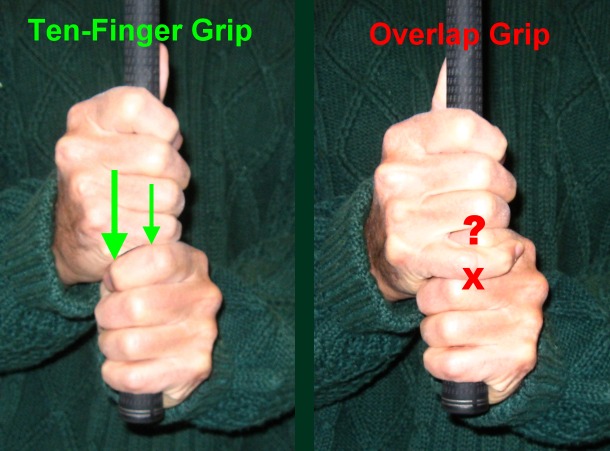
As Dave and I discussed the swing, the reason for the grip changes suddenly became clear to me! Let's look again at what I believe to be the fundamental fact of Leecommotion: the right arm pushes the hands around a circular track defined by the left arm. So the right hand must forcefully push the left hand around. This can come either from right-hand pressure on the left hand directly, or from the right hand gripping the shaft with enough force to transmit the pressure through the club itself. |
The figure
at
the left compares the ten-finger grip with the overlap grip,
specifically with regard to transmitting force from the right hand (top
hand in the pictures) to the left. Note that what holds true for the
overlap is at least as true for the interlock grip.The ten-finger grip butts the edges of the hands against one another, so the force exerted by the right hand (the green arrows) go directly to the left hand. And it is the last three fingers of the right hand providing that force, so it is natural to focus on them as key. But this is not pressure on the handle to hang onto it, but rather to establish a solid base with which to push against the left hand. The overlap grip is not nearly as efficient. The red question mark indicates most likely point for the force to be transmitted: from the ring finger of the right hand. Take it from a pianist like me that the ring finger is a very weak finger; you don't want to count on it for providing the force in a golf swing. The red X is even less likely as a source of power; there isn't an abutting surface in the proper direction to transmit the force. Finally, let's consider force transmitted from right hand to left via the handle of the club. The overlap and interlock grips were designed to allow the hands to act as a unit, and specifically to limit the influence of the right hand on the club. So that would be a poor way to convey the force, compared with the ten-finger grip. I conclude that the purpose of the ten-finger grip is to reinforce the primary element of the swing: the right hand powering the left hand around the circular arc. |
Aha Moment #3 - Everything ElseI asked a biomechanics specialist to look at Lee's video. No supporting material nor hints, just the video. He came back to me with a pretty good list of what makes up Lee's swing. He got the right-hand push, the stack'n'tilt, and a number of other key points. He also pointed out that none of them are brand new. The history of golf instruction includes every one of them, though perhaps not in this combination.That gave me the idea (the courage?) to look at the keys as independent, and play mix and match with them as I experimented with Leecommotion. In my assessment below, I evaluate each key as to how essential it is to the principal notion of the right arm driving the hands around a path defined by the left arm. Some seemed to be a matter of personal preference, rather than inherent to the swing. From my experimentation, one point did come through loud and clear. This is still a golf swing, and your fundamentals still have to be good. You probably can't teach Leecommotion to a raw beginner, without also imparting a lot of conventional fundamentals that are not Leecommotion. Examples:
|
| Key | Description | Assessment |
| Philosophy: | Whole
motion is (or at least should feel like) a hard right-hand punch
downward through the ball, thrown from the right shoulder
and reinforced
by a triceps-driven right-arm "piston". |
This is the entire essence of the swing. See more detail above. |
| Grip: | Ten-finger
grip, with the key fingers the last three of the right hand.
(Important note: For the conventional grip, it's the last three of the left
hand.) |
This is important to the swing. It transfers force from the powering right hand to the guiding left hand. See more detail above. |
| Stance: | Lee
says "lean" rather than "bend". When asked for a distinction, Lee says
to think of an image:
"leaning" means you are "reaching" the club to the ball. Your weight
will
wind up on the balls of your feet instead of centered or back
on
the heels. |
This presents an "athletic" and "ready" stance. I find it helps. I haven't tried it for a normal, left-side-pull swing, but I am fairly confident it would work equally well there. |
| Lee
also recommends a stance with the left foot turned out a bit (most
instructors recommend this), and the right foot drawn back a few
inches. That is, fundamentally, a closed stance. But, unlike most
closed stances, Lee keeps shoulders and hips aligned with the target
line; only the foot line
is closed. |
The swing is somewhat over-the-top by nature, especially if the right elbow is "flying" instead of tucked in front of the hip. It is possible that the closed stance might counter this a bit, and get the clubhead path back on line. I'm not sure how essential this is; as I practice more, I find it possible to swing down-the-line without it. | |
| Backswing: | Lift
club up with right hand, rather than one-piece takeaway. |
Seems to be optional. I found a more conventional takeaway left me less prone to the occasional duck-hook. But I'm sure it's fine for some golfers. |
| Shoulders
stay level, right shoulder maybe even lower than left. |
Lee's
swing is most emphatically a two-plane swing; he
has a fairly normal club plane (55º with a 7-iron), but a very flat
plane of shoulder rotation. I don't see that such a shallow shoulder
plane is needed for a right arm push. But I believe it is worse than optional. Lee made the point to me that a level shoulder turn is easier on the back. But I have recently seen two highly respected instructors, Sean Foley and Martin Hall, make precisely the opposite point. They emphatically believe that the left shoulder should go down on the backswing, in order to protect the back. |
|
| Club
between the
hands. |
Probably a good idea for a stable swing in general. | |
| It's OK for the left arm to bend at the top of the backswing. | I agree with this. It would increase the total club angle for people with flexibility problems, which could increase their distance. A bent left arm is only an issue late in the downswing. As long as it is extended later during inertial release, everything should be just fine. | |
| Weight shift: | Lee
proposes keeping the weight no farther back then the inside of the
right foot. |
There are good reasons for not letting the weight get further back than this, that apply to any golf swing. |
| His
is clearly a
stack'n'tilt move, keeping the weight pretty much left from address on. |
Stack'n'tilt? Full weight shift? Both work for me. I'm more comfortable with my full weight shift, and it does not seem to hamper the right-side swing. I'm pretty sure this one's optional. | |
| Downswing: | Start
by extending right shoulder sharply down. Follow by pistoning the
right arm down and across the body. The effort should be extended well
past the
ball, as if you had "punched through" a boxing opponent. Your body will
do whatever weight shift and turn is needed to realize the feeling as
motion. |
A more detailed description of the essence of Leecommotion. |
| This
often turns out as an over-the-top move. Lee claims that
over-the-top is
the most powerful move a golfer can make. |
I'm not sure about the assertion that over-the-top is the most powerful move a golfer can make. My biomechanics expert says it is not. But, in support of it, everybody pretty much agrees that straight pulls tend to go a long way. So let's leave it as "whatever works of you". | |
| Impact: | When
the hands reach the vicinity of impact, "Slap the ball with the right
hand." A few
other terms Lee has used for this move. "Stand the shaft up". "Stop the
left hand and push
the right hand under it." This
amounts to using hands, wrists, and arms to force a release of the club
at the ball. |
I suspect this is a bad idea, based on study I have done on the subject. I feel that it does no good at best, and it will hurt clubhead speed if executed at all too early. And "too early" is measured in a few hundredths of a second, so it's easy to be too early. |
A Note On ClubfittingLee has proposed flattening the lie of the irons substantially (as much as 5º or more). Some (Rock, at least) have interpreted this to mean that Leecommotion produces a flatter swing plane, which calls for a flatter lie. In discussions with Lee, I learned what was really behind the recommendation. Knowing the actual reasoning, let me strongly urge you not to flatten your lie angle without ascertaining the proper lie angle for you. Lee's recommendation has nothing to do with lie fitting. Here's the real story. Lee
sent me this picture of a Hogan iron from many years ago, with Lee's
own
notes added to it. The clubhead featured an "under-slung" hosel that
added some steel behind the heel. The point was to move the center of
gravity (CG) closer to the shaft axis, to make it easier to close the
clubface.This idea may (or may not) have originated with Hogan, but it
has continued to pop up from time to time, especially in the designs of
Clay Long. He added weight to the hosel behind the heel in the Peerless
PHD. When Long moved to Cobra, he did the same thing
with their
Gravity Back irons.Getting back to the marked-up picture, Lee drew his impression of the new CG as a black oval almost 1/4" closer to the shaft axis than Hogan's own staff did. Then he made the logical jump that, (a) this feature increased workability and (b) if your irons did not have this feature, you could acquire it by bending the iron significantly flat. That's correct, to some degree. But I think the whole idea is a bad one. Here is my logic:
|
Remember that I originally got involved in this to give
an engineering
answer to why it works. The only aspect that can be attacked directly
by engineering analysis is distance. And Rock's experience certainly
indicates that there is distance to be gained. It took me a while to
figure out why. Here's what I think is going on.![]() Let's start by reviewing the picture we saw before of the double-pendulum model of the swing. We must remember that the power comes from shoulder torque, which is generated from the ground up. The arms don't create the power, they transmit it from the shoulders to the hands. It is generated by large muscles between the feet (whose function is to provide a stationary base) and the shoulders. A torque is a push-pull pair of forces, separated by some distance. In the picture, the right arm push and left arm pull are separated by the width of the shoulders. Either or both (right arm push and/or left arm pull) can be used to transmit the torque. The picture shows a very simple case, where both arms are extended, and the hands are moving in a circular path around the center of rotation. That center is the spine at the base of the neck. This is a pretty accurate picture of what happens late in the downswing, say, the last 100 milliseconds (0.1 seconds) before impact. But
what about early in the downswing? The left arm is extended, but
across the chest. The right arm is folded, not extended at all. Is the
double-pendulum a useful model there?Here is a view looking down the spine of the golfer during the early part of the downswing. The shoulder torque is shown as a dotted black arrow, trying to turn the whole assembly of shoulders, arms, hands, and club counter-clockwise. Either arm can be used to transmit the torque, or both can share the load. But, in this position, they act rather differently than when both are extended: The left arm is extended across the chest. It typically exerts its force from the left shoulder all the way to the grip.[1] So the torque radius (the "lever arm") is the blue arrow. The right arm is folded next to the torso. If the right side is exerting the force to move the hands, it is the chain of limbs including the right shoulder and [folded] right arm. So the right side lever arm is the red arrow. Now a key point: The red arrow is shorter than the blue arrow. Why does that matter? Because the shoulder torque is transmitted to the hands by forces. A torque is a force acting over a distance -- a lever arm. The size of the torque is the force times the distance. Torque
= Force * Distance
Or, applying simple algebra:
Therefore, for a given torque, a shorter lever arm means a bigger force and vice versa. We have a shoulder torque to be transmitted to the hands. The torque is what it is; left side or right side will not change that. But the force at the hands will not necessarily be the same. The equation tells us that the smaller the lever arm is, the bigger the resulting force. So the shorter lever arm of the right side transmission will provide more force than the long lever arm of the left side. |
||||||
![]() Getting back to our model of the Leecommotion swing, let's look at what we get from an increased force on the hands. The hands are moving as if on a curved track, the path determined by the radius of the left arm from the left shoulder. As the diagram shows, most of the force accelerates the hands along that track. So we can expect an increased acceleration early in the downswing, until the arms extend and the force lever arm is the same as the radius of the "track". Later in the downswing, when the lever arm is the same as it would be for a conventional swing, then so is the acceleration. But more early acceleration means more hand speed (and, obviously, more rotational speed) later. And clubhead speed comes mostly from inertial release, which occurs in the latter stages of the downswing, usually the last 70-100 milliseconds. So what the right-side release does for us is gives us faster rotation by the time the hands start to release as the club is pulled outward by centrifugal force. We know that the formula for centrifugal force is:
So, whether we look at rotational speed (ω) or just plain velocity (v), the right-side swing gives us a stronger release due to increased early acceleration. And that is where Rock's extra distance comes from. (And mine! I have seen almost a full club's increase in my irons since I started the right-side swing.) |
||||||
Another way to look at it...Or two ways!On March 31, 2011, I exchanged a few emails with Ben Maffitt, who is also working to convert his longtime swing to Leecommotion. (By this time, Leecommotion has been renamed "C-Motion". I respect that, and will call it that in the future. I'm not going back to rewrite the rest of this article, nor all my links to it.) In our conversation, I came up with a few alternative ways to state the previous few paragraphs. It helped Ben, and he encouraged me to include it in the article to make the explanation more accessible. The first way to paraphrase it is basically a briefer statement of the basic principle: Lee
has reduced the lever arm
through which the shoulders convert their torque into force on the
hands. A shorter lever arm for the same torque results in more force.
More force accelerates the hands faster. By the time the arms are more
extended and actual release is occurring, the hands are moving faster
than they would be with a conventional swing. That means faster
rotation during release, and thus more clubhead speed and more distance.
The
second explanation has to do with bicycles.
I used to be very much into bicycling, and even got into the technical
aspects of it. (Big surprise, eh?) In the mid-1980s quite a few
cyclists who were also PC users designed their gearing ratios with a
program I developed. So a bicycle gear
analogy was a natural for me.The picture at the right shows how a bike is powered. The short story is:
When you apply force to the pedals, you are applying a torque to the sprockets. The amount of torque is the pedal force times the length of the pedal crank. torque = pedal force * pedal crank lengthThis torque is applied to the sprocket that the chain is on, which causes tension -- a force -- in the chain. How much force. It is created by a torque, and we know: torque =force * length of lever armSo the chain tension is given by: torque = chain tension * sprocket radiusConclusion: You want more chain tension to help power up a hill? Use the smaller front sprocket! The math is easy, the concept is completely sound, and it all agrees with cyclist experience everywhere. How does this relate back to the golf swing? What C-motion does for the golfer is shift to a smaller sprocket. The torque from the shoulders is applied to the hands through a folded right arm (small sprocket) rather than an extended left arm (big sprocket). Result: an increase in the force available to accelerate the hands in the early part of the downswing. |
||||||
Numbers pleaseOK, now we know that the shorter lever arm gives more force to the hands, which makes for higher hand speed when the club is release, And that, in turn, means higher clubhead speed and ultimately more distance.But how much extra distance? Does the difference in lever arm account for the distance Rock gained? In a word, yes! I was too lazy to come up with an exact model for the Leecommotion swing and a computer program to simulate it. That is not exceedingly difficult as a physics problem; maybe equivalent to a Masters thesis in mechanical engineering. But that was more effort than I wanted to spend on it. As it turned out, I didn't have to. I used a couple of modifications to the standard double-pendulum model of the swing, so I could use an already-existing computer program, SwingPerfect by Max Dupilka. As it turned out, the variable lever arm was hard to simulate directly, but it was not hard to come up with a calculation that gave an optimistic estimate and another that gave a conservative estimate. (Engineers do this all the time. It's called finding an "upper bound" and a "lower bound" on the performance of a system.) In case you're interested in the details of the model, I go through them on the next page. If you just want the executive summary, here is a synopsis of what I did and the results:
![]() Here is a chart of the results above, graphed by TrajectoWare Drive. Rock's conventional-swing drive goes 250yd, and his Leecommotion drive goes 280yd. The Leecommotion drive is clearly within the range between the optimistic model (upper bound) and the conservative model (lower bound). So it is reasonable to conclude that Rock's distance gain is real, and is due mainly to the shortened lever arm of the right side, compared with a left-arm swing. |