 Here is a graph adapted
from the paper, showing the muscular
torques that were exerted during the optimized swing. Here is a graph adapted
from the paper, showing the muscular
torques that were exerted during the optimized swing.
We can estimate the angles (the Q_
values) just looking at the diagrams above the graph. The angles release from the
inside out. That is:
- The torso turns first.
- Before
the torso has finished its rotation, the arm separates from the chest
(torso) and starts to angle outward. That is the shoulder angle
increasing.
- It is not until quite late in the downswing that the wrist
cock angle begins to release.
So,
for anyone who isn't convinced by the double pendulum model that
clubhead lag is a major contributor to clubhead speed, here's another,
more detailed, model that says so.
As the torso and shoulder angles release, they are driven by the
corresponding torques. But the same
is not true of the wrist angle!There
is only a small blip of wrist torque as the club begins to
release, and it drops down again immediately. MacKenzie assures me that
this does have a material effect on the clubhead speed. But, judging
from the work done by the blip, it cannot be a large effect. Like the double pendulum model, the MacKenzie model
gets maximum clubhead speed from centrifugal release, not from hitting
with the hands.
Another point to note: the large-muscle torques,
the shoulder and especially the torso, continue to provide accelerating torque
right through impact. In fact, the torso torque is increasing until
immediately before impact.[1] That is a lesson we could also learn from
the double-pendulum model (see my article on accelerating through impact);
but the fact that a speed-optimized model recommends it definitely
reinforces the lesson.
In short, the four-rotation model refines where the power comes from to
create clubhead speed, but it doesn't undo anything we learned from the
double-pendulum model about achieving distance. M_Torso and M_Shoulder
combined represent the shoulder torque of the double pendulum, along
with the lateral movement of the shoulder pivot. Before, we lumped them
together as part of the body's contribution. Now we can separate out
the contribution of the left shoulder extending the arm away from the
body. But "The Paradox" -- the most counterintuitive lesson from the
double-pendulum model -- remains intact.
Clubface Squaring
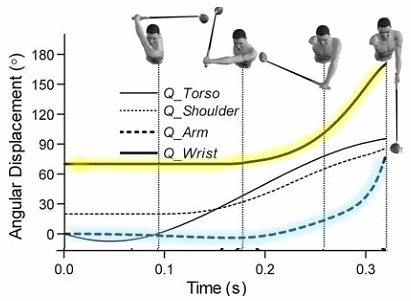 Here
is another graph with another lesson. It shows the actual angles over
the course of the downswing. I have highlighted the wrist cock angle Q_Wrist
(in yellow) and the arm
rotation angle Q_Arm
(in blue).
The wrist cock angle, we should certainly know, is the angle between
the club shaft and the left forearm at any time during the downswing.
The arm rotation angle is closely related to how much the face of the
club is open or closed, especially in the vicinity of impact. Here
is another graph with another lesson. It shows the actual angles over
the course of the downswing. I have highlighted the wrist cock angle Q_Wrist
(in yellow) and the arm
rotation angle Q_Arm
(in blue).
The wrist cock angle, we should certainly know, is the angle between
the club shaft and the left forearm at any time during the downswing.
The arm rotation angle is closely related to how much the face of the
club is open or closed, especially in the vicinity of impact.
The important thing to note here is that the shape of the two curves is
very similar, almost identical. Therefore, you can assume that shaft
rotation and clubface closure angles track the club's release angle
during the downswing, for purposes of back-of-the-envelope estimates at
the very least.[2] I have used
this in the past, to estimate things like how much shaft torque it
takes to square the clubface given the moment of inertia of a driver
head. It is useful because there are tools to calculate or estimate the
club's angular velocity during release. So we can also use those
methods to estimate clubface closure rates during release.
MacKenzie's results say that this gives a very reasonable estimate. To
the extent that the curves don't match exactly, the estimate will not
be exactly correct. But it will give a good enough approximation
for most purposes.
|
Swing Plane
The model of the swing shows that there is no constant "swing plane",
whether you are talking about the left arm's plane or the club shaft's
plane. MacKenzie plots the left arm plane, and it starts very flat:
about 25º, the way we usually think of the plane -- that is the angle
from horizontal. It gets even flatter (under 20º) early in the
downswing, then steepens considerably. By the time of impact, it is up
to 50º, a more reasonable number for a driver. (But still not as steep
as we would expect from a driver's lie angle.)
MacKenzie references a paper by Coleman & Rankin,
in which they photographically measured the swing plane of a variety of
golfers. (Seven right-handed male golfers with handicaps ranging from
zero to fifteen.) Let's see what lessons are to be learned from both
papers about the "swing plane".
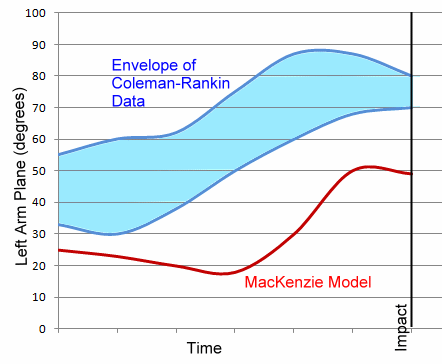 The
picture at the right shows the plane of the lead (left) arm over the
time of the downswing, with the transition on the left and impact on
the right.[3] I have combined
all seven curves from the Coleman-Rankin study into an "envelope" that
contains all the data points. The
picture at the right shows the plane of the lead (left) arm over the
time of the downswing, with the transition on the left and impact on
the right.[3] I have combined
all seven curves from the Coleman-Rankin study into an "envelope" that
contains all the data points.
How consistent is Coleman-Rankin's data with MacKenzie's model?
- Every
golfer in the Coleman-Rankin study was at least 20º steeper at impact
than he was at transition (the beginning of the downswing). The
highest-handicapper in the study showed a 50º variation of left arm
plane during the downswing, and even the scratch golfers had a 30º
variation. The MacKenzie model shows just over a 30º variation,
certainly consistent with Coleman-Rankin.
- The
left arm angle at impact was much steeper for Coleman & Rankin
(70º-80º) than MacKenzie (50º). A few degrees (certainly less than 10º,
and probably more like 5º)
might be attributed to the fact that Coleman-Rankin's golfers were
swinging a 5-iron, and MacKenzie's a driver. But the differences are
too great for the choice of club to be the only difference.[3]
- Most of the golfers also showed flattening early in the
downswing increasing and even peaking, like MacKenzie's model. But this
last point does not seem to be a quality-of-golf issue; Coleman &
Rankin's data includes two scratch golfers, one with the further
flattening and one without. So early flattening does not seem to be
something that needs to be either taught or discouraged -- unless... If
MacKenzie's arm plane changed significantly in going from the best
golfer match to the best clubhead speed, then maybe there is something
here worth looking at. There is not enough information presented in the
paper to tell.
Bottom line: Even though numbers and details disagree, both papers show
that the left arm does not stay in a plane during the downswing. The
left arm plane's variation during the downswing ranged from 30º to 50º.
|
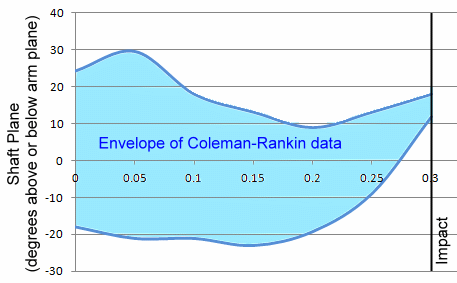 Coleman & Rankin
also ascertained that the club shaft
plane is
not the same as the left arm plane, and often not even close. Some were
above the left arm plane and some below. Again, it's not a
quality-of-golf
issue; one of the scratch players started about 20º above and the other
almost
the same amount below. And these were not the extremes either; those
ranged from 30º above to 23º below the left arm plane. (Independent of
the
left arm plane for that golfer, there was about 30º of variation
there, too.) Coleman & Rankin
also ascertained that the club shaft
plane is
not the same as the left arm plane, and often not even close. Some were
above the left arm plane and some below. Again, it's not a
quality-of-golf
issue; one of the scratch players started about 20º above and the other
almost
the same amount below. And these were not the extremes either; those
ranged from 30º above to 23º below the left arm plane. (Independent of
the
left arm plane for that golfer, there was about 30º of variation
there, too.)
It is worth noting that the Coleman & Rankin data shows a much
tighter grouping at impact.
The shaft plane at impact was centered around 15º, with only the
15-handicapper more than 3º
away from this number. (And both scratch golfers were spot on it.) But
even this final angle is not zero, as you might expect. Centrifugal
force is trying to straighten out the line from shoulder to clubhead,
via the tension it puts on the shaft. But all this tension seems to
produce not a straight line, but an upward angle between 12º and 18º.
I verified this by looking at a sampling of about a dozen down-the-line
shots of good golfers at impact. (Most of them are celebrated pros; the
golf magazines love to do full sequence shots of them.) In every case,
the plane of the club was above the plane of the left arm in the impact
photo. The right forearm was frequently on the shaft plane, but the
left arm was above it. I did not measure the angular difference, but
15º is not a bad estimate by eye.
Could it be that the minimum wrist cock (at least the minimum without
straining) is in this vicinity? That would explain the Coleman &
Rankin results. When we look at MacKenzie's results, that shows a
residual Q_Wrist
(wrist cock) of about 10º at impact.
While not the exact same number, it is in the right
direction and the right ball park. And 10°-20° seems to agree with the
range-of-motion limitation of ulnar deviation, which controls how well
the shaft can line up with the lead arm.
What can we take away from all
this?
We have a sort of negative lesson here. We learned that the swing is
not
on a single plane. Moreover, every golfer departs from plane in a
different way, and almost all of those deviations are pretty
significant, not trivial. Finally, the best golfers in the sample
differed in opposite directions. My conclusion is that we have
identified another case of something that may be good instruction even
if it isn't essential to the swing. How can that be?[4]
The data says fairly clearly, there is no one swing plane (nor one
pattern of planes, since the swing plane varies during the downswing) that is superior to
the others. On the other hand, working on a "classic" swing plane (a la
Hogan) may be the surest way to a good clubhead path at impact, not the
beginner's usual outside-in path. But obviously one or both of the
scratch players in the sample were able to get a good clubhead path
with very different approaches to the swing plane. So it isn't
essential to a good clubhead path, but it may be the best way to teach
a good clubhead path.
|
 But quite a few
researchers have verified that there is activity outside a single plane
which might be of interest.
MacKenzie accounts for this in his model.
But quite a few
researchers have verified that there is activity outside a single plane
which might be of interest.
MacKenzie accounts for this in his model.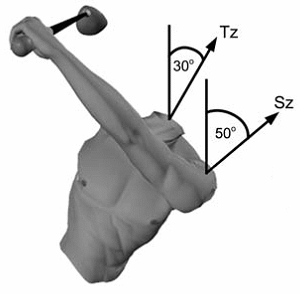
 Four Rotational
Axes
Four Rotational
Axes
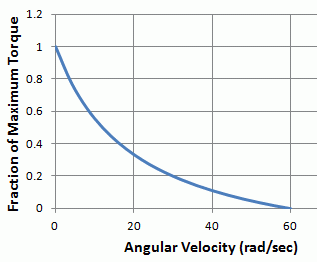 On
top of that, a moving joint cannot exert as much torque as a
stationary joint. Think of this analogy. You are pushing an automobile
along the street. As long as the car is not moving, you can apply the
maximum force your body is capable of. Once the car starts moving, it
is harder to apply a force to it, since it is moving away from you. You
have to maintain your velocity as well as apply a force. In fact, at
some point the car may move faster than you can keep up. At that point,
your ability to exert a force is down to zero. Alternatively, consider
pedaling a bicycle going really fast downhill; you can't apply force to
the pedals because your feet can't keep up.
On
top of that, a moving joint cannot exert as much torque as a
stationary joint. Think of this analogy. You are pushing an automobile
along the street. As long as the car is not moving, you can apply the
maximum force your body is capable of. Once the car starts moving, it
is harder to apply a force to it, since it is moving away from you. You
have to maintain your velocity as well as apply a force. In fact, at
some point the car may move faster than you can keep up. At that point,
your ability to exert a force is down to zero. Alternatively, consider
pedaling a bicycle going really fast downhill; you can't apply force to
the pedals because your feet can't keep up. Right arm