Sequence of the
joints' firing:
Look again at that rainbow-coded table, showing the order of peaking of
the effort in the various joints. Particularly, let's look at the
scratch golfer, because there is an important lesson there.
A close look shows that the scratch golfer has a very organized and
easily described sequence.
- It is from the
ground up, until it reaches the shoulders.
This is what the best textbooks say the golf swing should be, but it's
really nice to have scientific confirmation.
- On top of that, at each
level (ankles, knees, etc), the left side fires before the right side.
The only place this pattern is broken is beyond the shoulders -- the
elbows and wrists. And that's not a problem. They are nearly simultaneous anyway, as noted above.
|
The
importance of wrist cock:
This lesson is emphasized by the accompanying graph from Nesbit's
paper, to which I have added a little. I have added the red curve,
which is the clubhead speed that would have been generated by the same
hand speed but never any wrist cock. I only plotted one curve, based on
the scratch golfer (the solid line in the black curves).
The difference at impact is about 74% of the clubhead speed. That is,
the clubhead speed with a good wrist cock is 74% higher than that with
no wrist cock. That's huge! Now in reality, it won't be that large a
difference, because
the dynamic forces on the hands are somewhat different when you release
the wrist cock. But even half that difference is 37%, and reality is
more than that.
For
a golfer who can swing a driver at 100mph with a full wrist cock, the
loss of clubhead speed from no wrist cock is more than 80 yards. That
is a lesson of
a substantial size. Of course, we saw it very clearly with the simpler
models; this was very clear even from the double pendulum model.
|
The importance
of wrist torque:
The previous observation was purely kinematic -- only motion, no torque
considered. What is the kinetic role of the wrist? If we look back at
the graph of total work of the various joints,
we see that the wrists contribute very little energy. This reinforces
the conclusion of the earlier (forward dynamics) models that wrist
torque is not a factor in producing clubhead speed.
We came to this conclusion based on total work at each of the joints.
But the researchers also have the torque-vs-time graphs for each joint
(not published in the paper). They must also support this conclusion, because Nesbit writes, "Just
before impact the wrists momentarily approximate a “free hinge”
configuration as the golfer merely holds on to the club as its momentum
carries it to impact. By the time impact is reached, all torque
components are in opposite directions because the wrists cannot keep up
with the rotational speed of the club at this time in the downswing."
That is consistent with my conclusions in my article on hitting with
the hands.
In a private communication, Sasho MacKenzie has also supported this
point, citing the torque-speed relationship whereby the faster a joint
is turning the less torque it can exert.
Note that this is not as strong a statement as the earlier models made:
that wrist torque assisting release is deleterious to clubhead speed.
We'll see why it didn't make the stronger statement below, when we
discuss the limitations of the model.
|
 The importance of
path of the hands:
Here's another purely kinematic observation. Nesbit points out that
there was a strong correlation between skill (reflected as handicap)
and the path of the hands in the downswing. Specifically, he measured
the "swing radius ratio", the degree to which the hands follow a
tighter curve at impact than earlier in the downswing. The importance of
path of the hands:
Here's another purely kinematic observation. Nesbit points out that
there was a strong correlation between skill (reflected as handicap)
and the path of the hands in the downswing. Specifically, he measured
the "swing radius ratio", the degree to which the hands follow a
tighter curve at impact than earlier in the downswing.
What does this mean? Here are "strobe animations" of two of the swings
in the paper: the lowest- and the highest-handicap golfers. I have
added two curves to each of the swings:
- A blue curve,
tracing the path of the end of the grip early in the downswing.
- A red curve, tracing the
path of the end of the grip in the
vicinity of impact.
You can see that the scratch golfer has a relatively straight path
(very little curvature) in the blue curve, and a lot more curvature in
the red curve. The 18-handicapper is just the opposite -- much more
curvature early in the downswing than near impact.
Why does this matter? This is another way of delaying centrifugal
release until very late in the downswing, and emphasizing it late for
maximum clubhead speed. You don't have to use retarding wrist torque to
keep the clubhead lag; just minimze the path curvature early and
maximize the curvature late.
Note that the double-pendulum model cannot reflect this distinction; it
has a fixed upper pivot and a fixed-length upper arm, so the radius of
curvature is absolutely constant. Even allowing a lateral acceleration
of the
"fixed" pivot doesn't give enough variation of swing radius to study
this properly. We needed to go to a kinematic study to even see this
effect. Nesbit has written a whole paper on just the subject of the curvature
of the hand path (Journal of Sports Science and Medicine, 2009, #8,
p235, co-authored with Ryan McGinnis).
|
Strength vs
Flexibility: Nesbit concluded that, "Swinging
harder does little to generate additional club head velocity. Swinging
further (expanded range of motion) has the potential to generate
additional club head velocity if the subject possess sufficient
muscular power. Exercise programs thus should promote flexibility, and
strength training for power as opposed to just strength development.
Subject differences in work, power, force, and torque do translate to
differences in club velocity, however not to the degree one
would expect. "
Let's look at each of these points:
- Differences in strength do
not make for proportional differences in clubhead velocity. We
have seen this before, in our lessons from the double
pendulum model.
- Expanded range of motion
can generate additional clubhead speed. Again, we saw this when
we studied the double
pendulum model.
That study said specifically that wrist cock gave more velocity gain
than did shoulder turn. Nesbit didn't come to that conclusion, but it
is probably true.
- Exercise programs should
promote flexibility first. Any strength training should be for power,
not just strength.
That is certainly a reasonable conclusion to be drawn from the study.
I'm not sure how one trains "for power as opposed to just strength
development". I imagine it has to do with speed or reps, as opposed
to maximum force, but I'm not sure.
|
 The full-body model
that Nesbit uses is based on GeBOD (Generator
of Body Data) model, which has been
around since the mid 1990s. It seems to have been used mostly for
computer-simulated crash test dummies. (They must have been watching my
golf swing.) Nesbit has chosen to model a golf swing with a GeBOD model
having 15 body parts and 14 joints. In the diagram at right, I have
labeled the body parts, in a picture from both the
papers. The joints identified are the obvious meetings of the parts,
with the addition of wrist joints hinging the club to the ends of the
forearms.
The full-body model
that Nesbit uses is based on GeBOD (Generator
of Body Data) model, which has been
around since the mid 1990s. It seems to have been used mostly for
computer-simulated crash test dummies. (They must have been watching my
golf swing.) Nesbit has chosen to model a golf swing with a GeBOD model
having 15 body parts and 14 joints. In the diagram at right, I have
labeled the body parts, in a picture from both the
papers. The joints identified are the obvious meetings of the parts,
with the addition of wrist joints hinging the club to the ends of the
forearms.
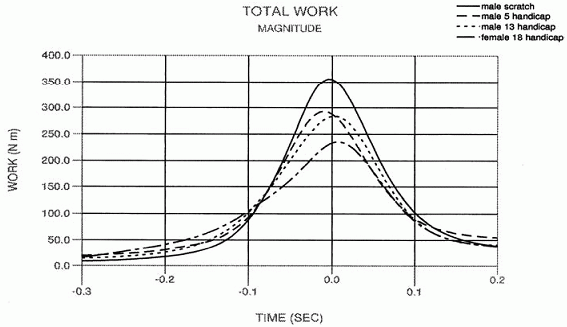 Here
is another output from the Nesbit-Serrano paper. It is the total amount
of work done by the golfer over the course of the downswing. The time
scale is with respect to impact; 0.0 seconds is the moment of impact
between clubface in ball.
Here
is another output from the Nesbit-Serrano paper. It is the total amount
of work done by the golfer over the course of the downswing. The time
scale is with respect to impact; 0.0 seconds is the moment of impact
between clubface in ball.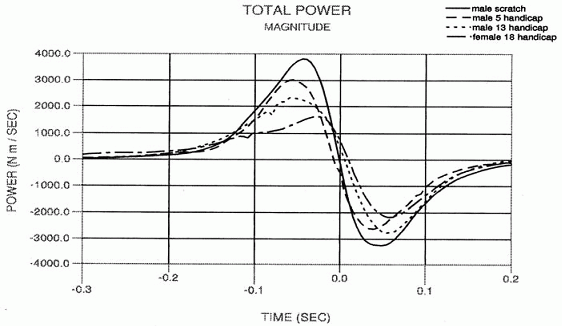 This
is even more apparent when we look at power. Power is the rate at which
work (energy) is being input into the system. So, at the peak of total
energy, the power should be zero, and going from positive to negative.
Why? Because before the peak, energy was being input to the system
(positive work); after the peak energy is leaving the system (negative
work).
This
is even more apparent when we look at power. Power is the rate at which
work (energy) is being input into the system. So, at the peak of total
energy, the power should be zero, and going from positive to negative.
Why? Because before the peak, energy was being input to the system
(positive work); after the peak energy is leaving the system (negative
work).